Category: Uncategorized

  • Real Estate Thank-You Cards: Choosing the Right Card for Closings, Referrals, and Farming

    Real Estate Thank-You Cards: Choosing the Right Card for Closings, Referrals, and Farming

    A real estate agent never sends just one kind of thank-you card. The note that reaches a buyer at the closing table, the postcard that lands in three hundred mailboxes after a sale, and the card that reminds a past client you still exist three years later are three different print jobs. They use different sizes, they mail at different postage rates, and they make sense at very different order quantities. Choosing the wrong format wastes money in both directions: overspending on heavy folded cards for a farming drop, or sending a flimsy postcard to someone who just trusted you with the largest transaction of their life. This guide maps each moment in the client relationship to the card that actually fits it.

    The closing card is the one clients keep

    The card you give or mail at closing is a keepsake, and it should feel like one in the hand. A folded card is the right call here. A 5×7 folded card (which folds down to 5×3.5) or a 4.25×5.5 A2 folded card gives you a front panel for your brand and an inside spread for a handwritten note. Print it on a heavy cover stock in the range of 100 to 130 lb (roughly 270 to 350 gsm), or 14 to 18 pt, so it stands on a mantel without curling. This is the one place where a specialty finish earns its keep: foil stamping or letterpress reads as considered rather than mass-produced. Just plan for the calendar, because those processes typically run 7 to 15 business days at the printer versus 3 to 7 for straight digital printing, before any shipping time.

    Because a folded card is two thicknesses of stock inside an envelope, it mails at the First-Class letter rate, not the postcard rate. Order these in small, undated batches, or buy blank premium stock you personalize by hand. Keeping the design free of dates and specific listings means leftover cards never go stale in a drawer.

    Farming postcards work through repetition

    Geographic farming is a volume game, and the economics only work on the postcard rate. A one- or two-sided flat card at 4×6, 6×9, or 6×11 is the standard tool for “Just Listed,” “Just Sold,” and monthly market-update mailings. Print these on 14 to 16 pt gloss or matte cover so they survive the mail stream without looking cheap.
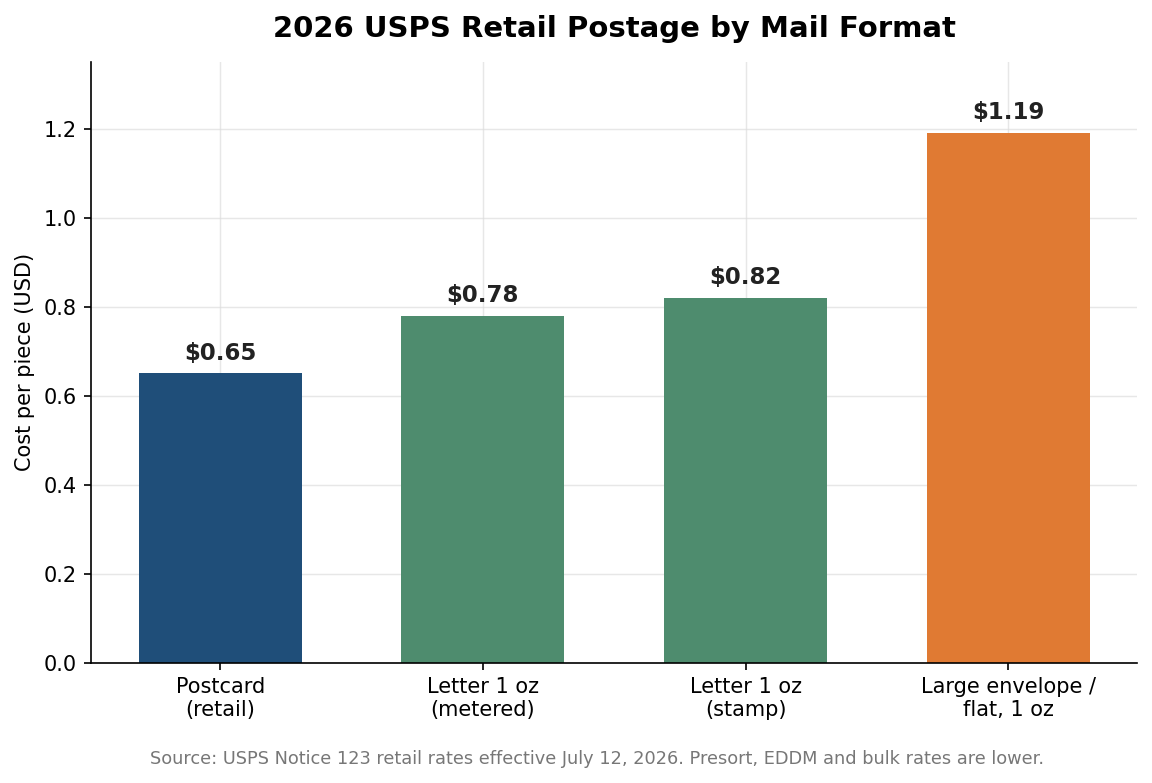
    Bar chart of 2026 USPS retail postage by mail format: postcard 65 cents, metered letter 78 cents, stamped letter 82 cents, large flat 1.19 dollars
    Postcard rate is the reason farming mail stays affordable; folded cards mail as letters.

    The size you choose changes the postage more than the printing does. To mail at the 2026 First-Class postcard rate of 65 cents, USPS requires the piece to fall between 3.5×5 and 4.25×6 inches and between 0.007 and 0.016 inches thick, which a 4×6 on 14 pt stock meets comfortably. Step up to a 6×9 or 6×11 and you leave postcard territory: those mail as letters or flats at higher rates, or through Every Door Direct Mail. EDDM Retail is worth understanding here, because it lets you blanket an entire carrier route without buying or maintaining a mailing list, at a per-piece postage cost in the low twenty-cent range rather than the retail stamp price. For a neighborhood you are farming, a run of 100 to 500 pieces per drop, repeated month after month, is the pattern that builds recognition; a single mailing rarely does anything.

    Referral and past-client cards keep the pipeline warm

    The cards that quietly generate repeat business go to people who already know you: past clients, your sphere, and the referral partners who send deals your way. Home-purchase anniversary cards, holiday cards, and simple “thinking of you” notes belong to this category. A flat 5×7 card or a modest folded card both work, and unlike farming mail, these are personal enough to justify the letter rate. Volume here is defined by the size of your database, often 50 to 300 pieces, and the smart move is to batch the whole year’s holiday or anniversary run at once so you are not paying setup costs four separate times. Keep the branding consistent with your closing cards so a client who has received several over the years recognizes them instantly.

    Sizes, postage, and what actually fits the envelope

    Three specifications decide almost everything about a card mailing: the trim size, the postage tier it triggers, and the envelope it needs. Flat cards run 3.5×5, 4×6, 4.25×5.5 (A2), and 5×7. The 4×6 and the A2 sit at or near the upper bound of the postcard rate, while a 5×7 flat or any folded card crosses into letter postage. Envelopes track the card: a 4.25×5.5 card pairs with an A2 envelope, and a 5×7 card, whether flat or folded, needs an A7. If you plan to mail, confirm the finished piece against current USPS dimensional and thickness limits before you print a thousand of anything, because a card that is a sixteenth of an inch too tall gets billed at the next tier up.
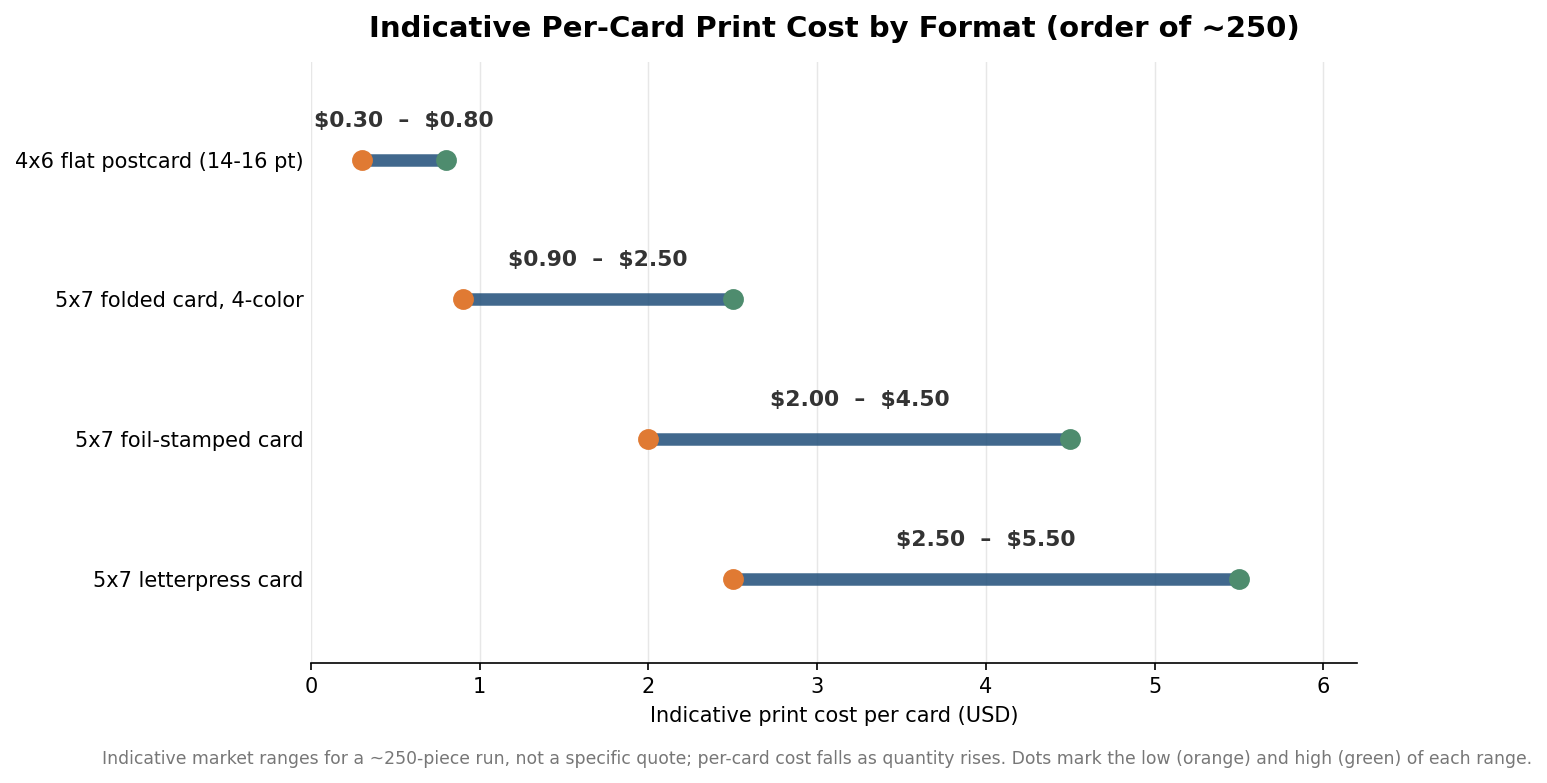
    Range plot of indicative per-card print cost by format for a run of about 250 pieces, from 4x6 postcards to letterpress cards
    Indicative per-card cost by format for a roughly 250-piece run; costs fall at higher quantities.

    Cost per card falls as three things change: quantity goes up, the stock gets lighter, and the finish gets simpler. The ranges above are indicative market figures for a run of roughly 250 pieces, not a specific quote, and they compress substantially at 500 or 1,000. A plain 4×6 postcard is cheap enough to mail monthly; a foil-stamped 5×7 is a once-a-relationship expense you reserve for closings. Matching the format to the moment is what keeps a full year of client touches affordable.

    Planning a year of touches

    The agents who stay in touch consistently tend to buy in three tiers. They keep a stack of blank premium closing cards on hand so a handwritten note can go out the day a deal funds. They schedule farming postcards as a recurring monthly print-and-mail so the design work happens once and the drops run on autopilot. And they batch the entire client-base holiday or anniversary mailing in a single fall order. When you order farming pieces, add 10 to 15 percent overage to cover reprints, new movers, and the addresses that inevitably get added mid-campaign. Build the lead times into your calendar, since specialty finishes need those extra days, and keep the core designs undated so nothing you paid for ends up in a recycling bin. Choose the card for the moment, and the budget takes care of itself.
  • Thank-You Card Paper, Explained: Weights, Coatings, and Finishes

    Thank-You Card Paper, Explained: Weights, Coatings, and Finishes

    Two thank-you cards can carry the same printed design and feel completely different in the hand, and almost all of that difference is the paper. Weight, coating, and fiber decide whether a card feels like a flyer or like something worth keeping, and they also decide which print finishes are even possible. Here is how card stock actually works, in the terms you will see on a spec sheet.

    Cover weight and text weight are not the same number

    The single most confusing thing about paper is that the pound number depends on the type of stock. An “80 lb text” and an “80 lb cover” share a number but are entirely different papers: 80 lb text is a foldable sheet in the range of stationery and brochures, while 80 lb cover is a rigid card stock. That happens because a paper’s pound rating is the weight of 500 sheets at that stock’s own basis size, and cover, text, and bond stocks each use a different basis size. For thank-you cards you almost always want cover stock, the card family, not text weight. When a printer lists “80 lb cover” they mean a genuine card; when a supplier advertises a heavy “100 lb” gloss that turns out to be text weight, it will feel far flimsier than a 100 lb cover.

    This is why grams per square meter, or gsm, is the less ambiguous unit. Because gsm measures the actual weight of a one-meter-square sheet regardless of stock type, it does not shift meaning between cover and text. If you only remember one habit, ask for the gsm; it removes the pound-rating confusion in one step.

    What the weights actually feel like

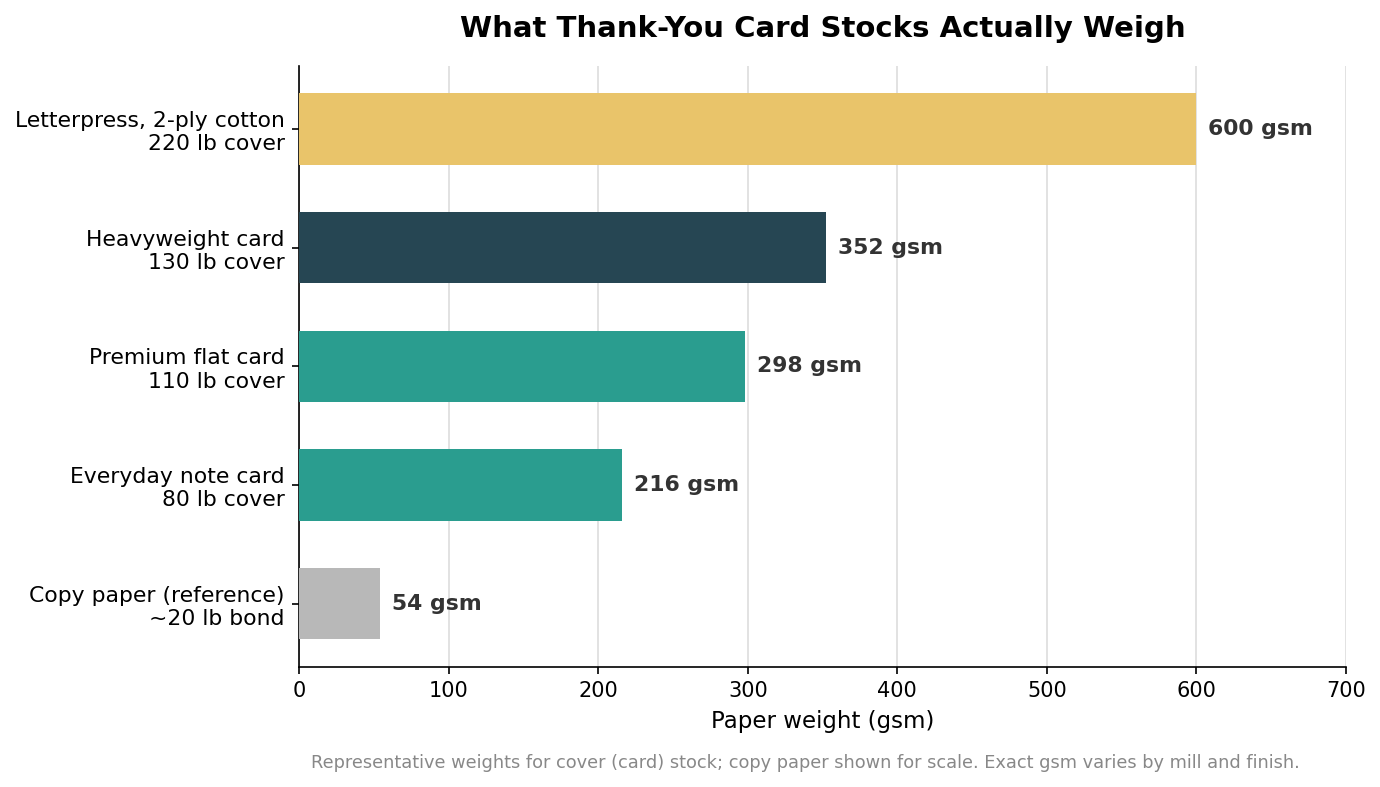
    Card stock for note and greeting cards lives in a fairly narrow band. A 65 lb cover, about 176 gsm, is on the light end and reads more like a postcard or an inner layer of an invitation. An 80 lb cover, about 216 gsm, is the most commonly used card stock and a sensible everyday thank-you card. Step up to 100 lb cover at roughly 270 gsm for a noticeably sturdier feel, 110 lb cover at about 298 gsm for a popular premium weight, and 130 lb cover at around 352 gsm for a heavyweight card that feels substantial before you have printed anything on it. For scale, ordinary copy paper is only about 54 gsm, which is why even an everyday card feels several times more solid than a printout.

    Bar chart of card stock weights in gsm: copy paper 54, everyday note card 216, premium flat card 298, heavyweight card 352, letterpress two-ply cotton 600
    Where common thank-you card stocks sit by weight, with copy paper shown for scale.

    Heavier is not automatically better. Above roughly 300 gsm a single sheet becomes hard to fold cleanly without cracking, which is why folded cards often use a slightly lighter stock and a proper score line while flat cards can go as heavy as you like. The tactile jump buyers notice most is from an everyday 216 gsm to a premium 298 to 352 gsm; past that, weight is more about a specific luxury feel than about everyday quality.

    Reading a spec: pounds versus gsm

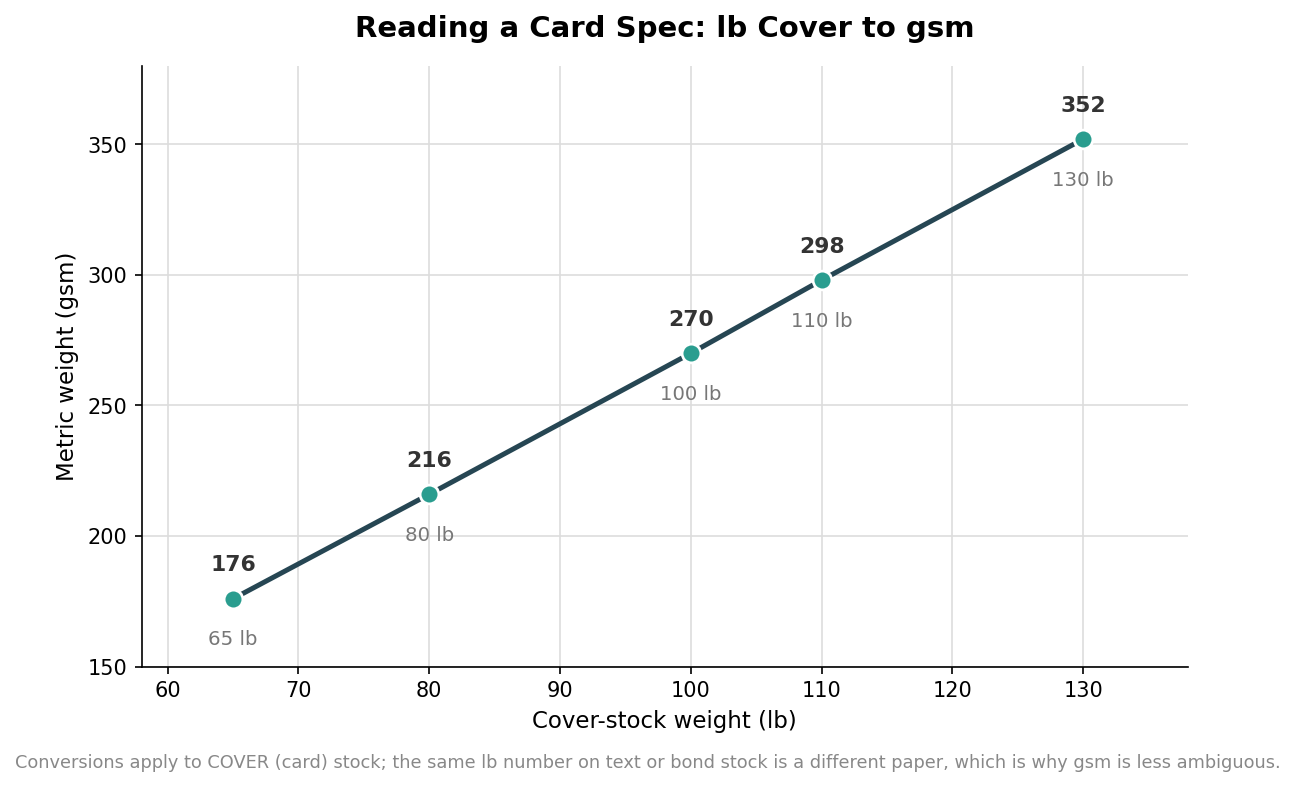
    When you compare quotes, translate everything into gsm so you are comparing the same thing. The common cover-stock conversions are steady: 65 lb is about 176 gsm, 80 lb about 216, 100 lb about 270, 110 lb about 298, and 130 lb about 352. These figures apply to cover stock specifically; run the same pound numbers against text or bond stock and you get different papers entirely, which is exactly the trap the two-weight system sets.

    Line chart converting cover-stock pounds to gsm: 65 lb is 176 gsm, 80 lb 216, 100 lb 270, 110 lb 298, and 130 lb 352
    Cover-stock pound ratings converted to gsm; the conversion holds only for cover (card) stock.

    Treat these as close reference points rather than exact constants. Different mills round differently and a given line may run a few grams heavier or lighter, so a spec sheet that lists both the pound rating and the gsm is doing you a favor. If a supplier will only give you a pound number, ask which stock type it refers to before you assume it matches another quote.

    Coated or uncoated changes both look and use

    Coating is a thin clay layer that makes paper smoother, and it is a genuine fork in the road for thank-you cards. A coated stock, whether gloss, matte, or silk, holds ink on the surface, so colors look more saturated and photographs stay crisp. The trade-off is that a slick coated surface can resist pen ink and smudge, which matters because a thank-you card is often handwritten. An uncoated stock lets ink soak in slightly, giving a warmer, more natural look and, crucially, a surface that takes a pen or a fountain-pen note without beading or smearing. Cotton and other premium uncoated papers push that tactile, letter-quality feel the furthest.

    Choose the coating around how the card is used. If the front is a full-bleed photo or a color-heavy brand design and no one will write on it, a coated stock makes the print sing. If recipients will handwrite a message, or you want the understated, textured feel that reads as premium stationery, uncoated is usually the better call. Many cards split the difference by printing a coated exterior for the artwork and leaving an uncoated interior panel for writing.

    Match the stock to the finish you want

    Print finishes are not universal; each one asks something of the paper. Standard digital and offset printing are the flexible options that run on most coated and uncoated card stocks, which makes them the default for full-color thank-you cards. Foil stamping presses a metallic layer onto the surface and works on coated or uncoated stock, but it wants enough weight underneath to take the pressure cleanly, so it pairs naturally with heavier cards. Letterpress is the most demanding: the deep, tactile impression that defines it needs a soft, thick cotton stock, typically a single-ply around 110 lb or 300 gsm, or two plies duplexed to roughly 220 lb or 600 gsm, in papers like the cotton stocks favored for the craft. Try to letterpress a thin, hard sheet and the impression will not hold.

    Start from the gsm, decide coated or uncoated by whether the card will be written on, and confirm the stock can carry the finish you are paying for. Get those three right and a thank-you card feels considered the moment someone picks it up, which is the entire point of sending one.

  • How to Spec a Custom Thank-You Card: Sizes, Envelopes, and Paper Weight

    How to Spec a Custom Thank-You Card: Sizes, Envelopes, and Paper Weight

    A custom thank-you card looks like a simple print job, but a handful of specifications decide whether it drops cleanly into its envelope, clears the post office at the standard rate, and takes a handwritten note without the ink feathering. Getting those numbers right before you approve artwork is what saves a reprint. This walkthrough covers the decisions in the order you should make them: size, fold, envelope, stock, and file setup.

    Card size sets up every decision after it

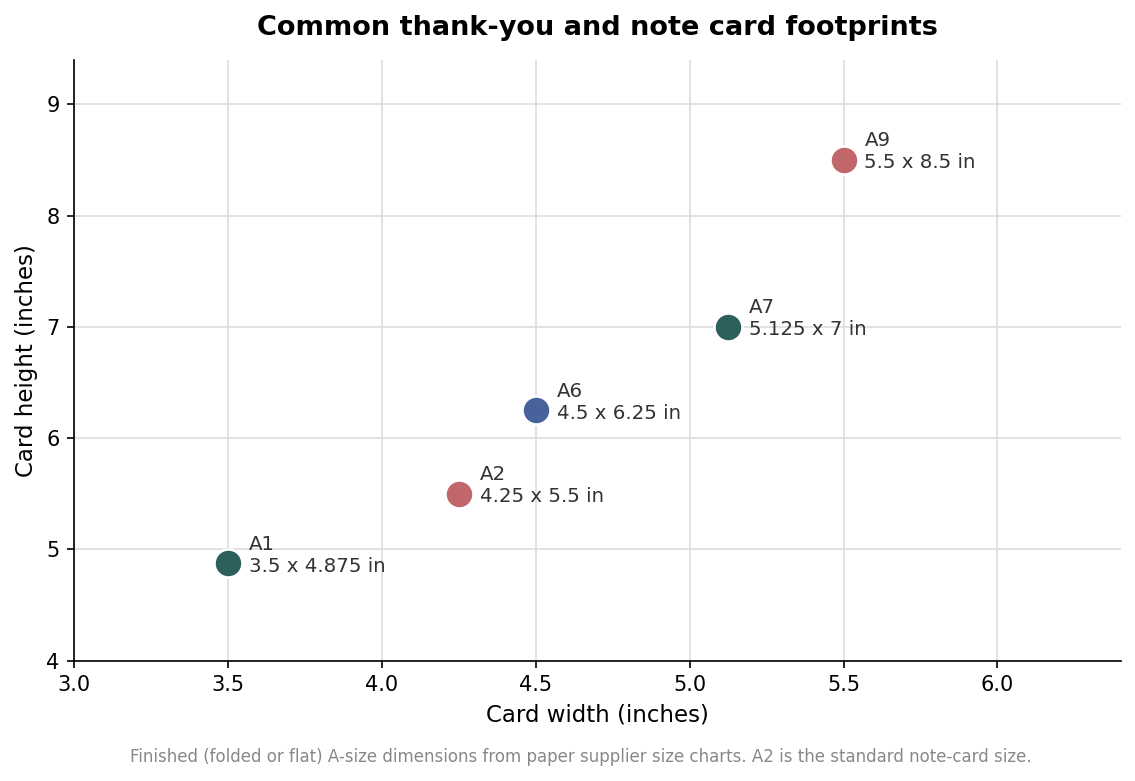
    Thank-you and note cards mostly follow the A-size system, and the finished dimensions are worth committing to memory because they cascade into envelope choice and postage. The A2, at 4 1/4 by 5 1/2 inches, is the default note-card size and the one most people picture when they think “thank-you card.” Step down to the A1 at 3 1/2 by 4 7/8 inches for a compact enclosure or an RSVP, or up to the A6 at 4 1/2 by 6 1/4 inches when you want more writing room. The A7, at 5 1/8 by 7 inches, is the popular five-by-seven format used for larger cards and invitations, and the A9 at 5 1/2 by 8 1/2 inches is about as big as a card gets before mailing rules start to complicate things. These finished dimensions apply whether the card is flat or folded.

    Scatter chart plotting width against height for A1, A2, A6, A7, and A9 card sizes in inches
    The A2 at 4.25 by 5.5 inches is the standard note-card size; A7 and A9 give more room but approach mailing limits.

    Flat or folded changes the file, not just the feel

    A folded card is physically a larger sheet. A folded A2 that finishes at 4 1/4 by 5 1/2 inches is printed on a flat sheet of 8 1/2 by 5 1/2 inches and scored down the middle, which means the print file has to be built at the unfolded size with a score line marked, not at the finished size. Flat cards are simpler: a single panel printed on one or both sides, ideal for postcards and for high-volume business thank-yous where you want a printable back for a message or a mailing panel. Decide this early, because it sets how many printable panels you are designing, two for a flat card and up to four for a folded one, and how the artwork is imposed on the press sheet. Folded cards also stand on their own on a desk or mantel, which some recipients like, while flat cards mail more cheaply and photograph better for a brand that reuses the shot in marketing.

    Match the envelope, then check the mail

    Every A-size card has a matching A-size envelope cut roughly an eighth to a quarter inch larger on each dimension so the card slides in without forcing. An A2 card pairs with an A2 envelope at 4 3/8 by 5 3/4 inches; an A7 card with an A7 envelope at 5 1/4 by 7 1/4 inches. Order the envelope alongside the card rather than sourcing it separately, since a near-miss on size is the most common reason a good-looking card arrives creased. Then sanity-check the mailing rules. A standard letter-size piece runs from a minimum of 3 1/2 by 5 inches to a maximum of 6 1/8 by 11 1/2 inches and must be at least 0.007 inch thick, so all of the A sizes qualify. The trap is shape: square envelopes and rigid or extra-thick pieces are treated as nonmachinable and carry a surcharge on top of regular postage. If you love the look of a square card, budget for that added cost per piece and take a fully assembled sample to the post office to confirm the rate before buying stamps in bulk.

    Paper weight and finish decide how it writes

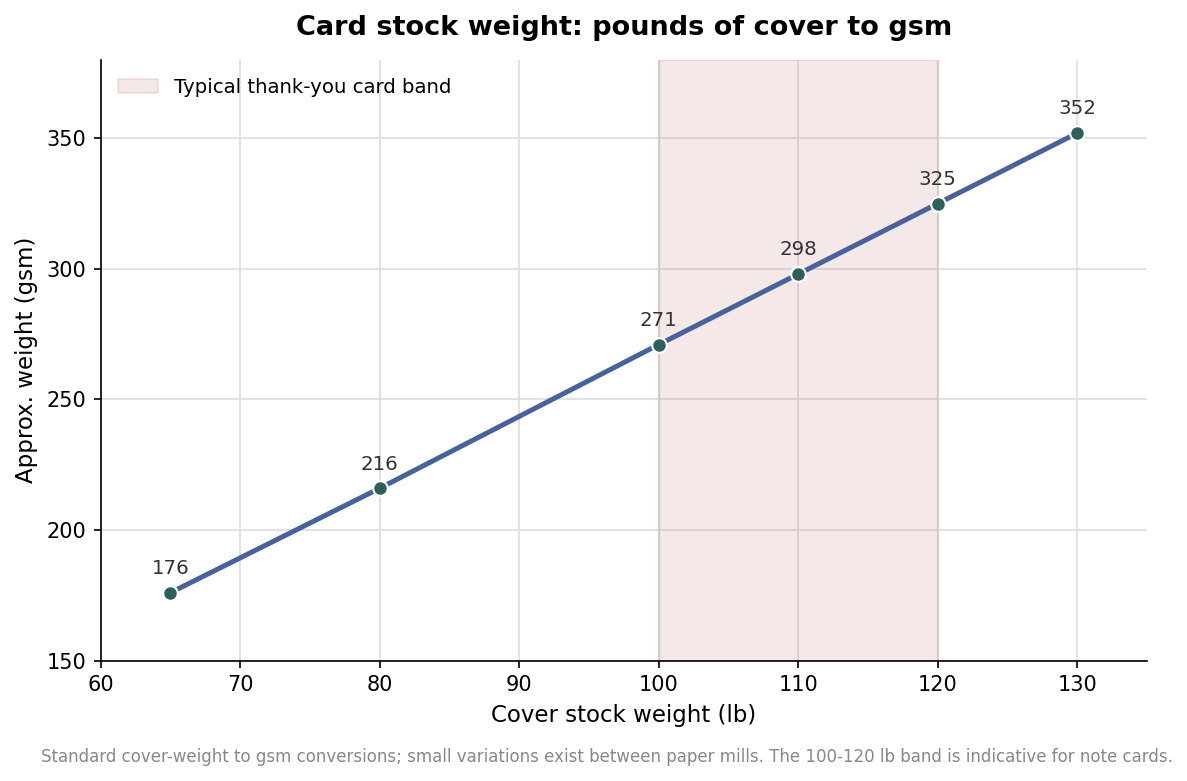
    Card stock is sold by weight, and the two systems you will encounter are pounds of cover stock and grams per square meter. For thank-you cards the useful band sits around 100 to 120 pound cover, which is roughly 271 to 325 gsm; that range feels substantial in the hand without being so thick that it resists folding or cracks at the score. Lighter 80 pound cover, about 216 gsm, works for inexpensive high-volume cards, while heavier luxe stocks climb past 130 pound cover, near 352 gsm, for a premium flat card that will never be folded. Postcards are often quoted in points of thickness instead, commonly 14 to 16 point. Finish matters as much as weight when the card will be written on: an uncoated stock accepts pen ink and absorbs it cleanly, while a glossy coated surface can smear or bead, so reserve coatings for cards that are printed-only and choose uncoated whenever a handwritten message is the whole point. If you want the tactile signal of quality without giving up writability, a soft-touch or matte-coated front paired with an uncoated writing panel inside a folded card is a common compromise.

    Line chart converting cover stock weight in pounds to gsm, with the 100 to 120 pound thank-you card range highlighted
    Most thank-you cards land around 100 to 120 pound cover, about 271 to 325 gsm.

    Set up the file so the proof matches the print

    Two setup habits prevent most disappointments. Add a bleed of one-eighth inch on every edge if color or artwork runs to the trim, so a slight shift on the cutter does not leave a white sliver, and keep important text and logos at least an eighth to a quarter inch inside the trim line in the safe area, since anything closer risks being clipped. Build the file at the correct flat size for your fold, export at 300 dpi, and then ask for a proof, ideally a physical one on the actual stock. Uncoated paper in particular renders color softer and a touch darker than a screen suggests, and a proof is the cheapest place to catch that before a full run commits. Settle size, fold, envelope, stock, and setup in that order and the finished thank-you card behaves exactly the way you designed it to.

  • Wedding Thank-You Cards: How Many to Order, Sizes, and Timing

    Wedding Thank-You Cards: How Many to Order, Sizes, and Timing

    The wedding is over, the gifts are logged, and now a stack of thank-you cards is the last thing standing between you and the finish line. The notes themselves take patience, but the ordering decisions in front of them are quick once you know what actually drives the choices: how many to buy, what size to send, which print method fits your budget, and when everything has to be in the mail. Here is how to settle each of those before you place the order.

    Order by household, not by headcount

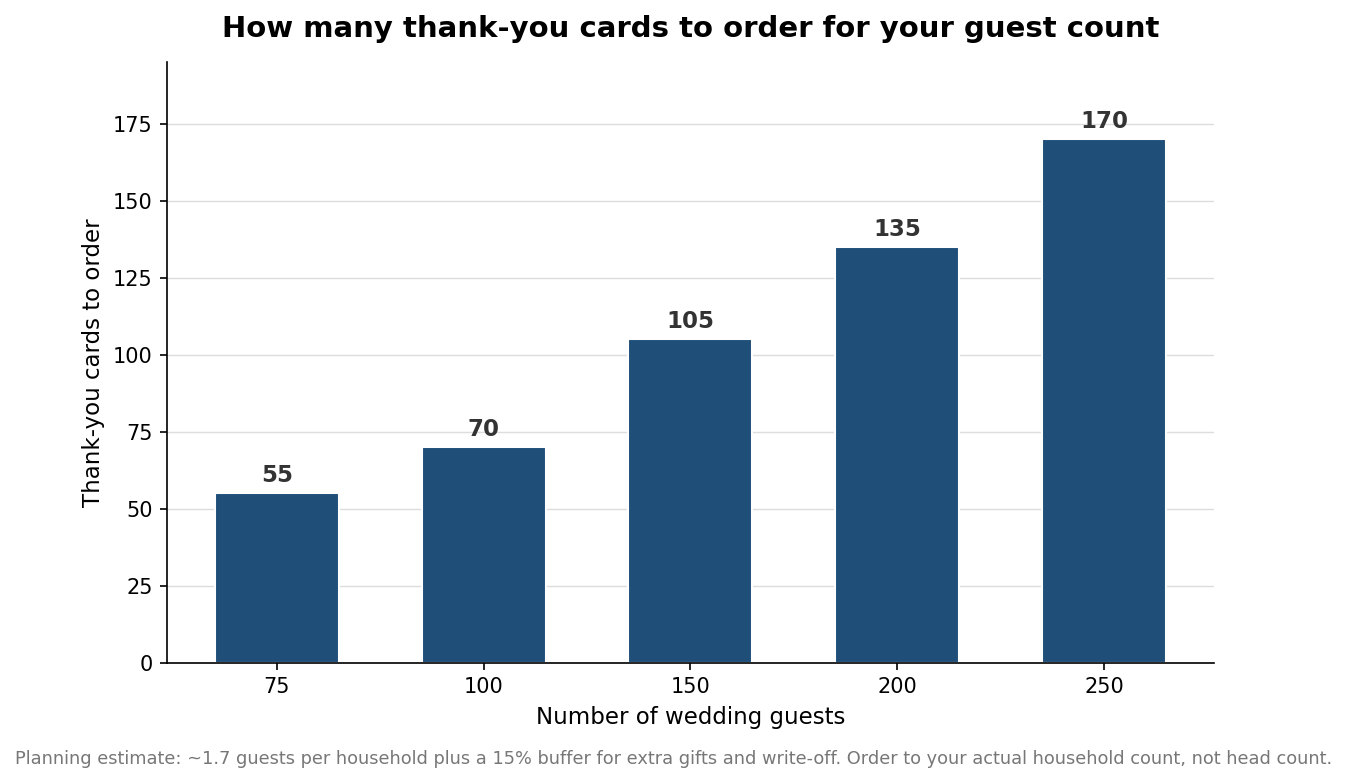
    The single most common mistake is ordering one card per guest. You are not thanking people, you are thanking gifts, and gifts arrive by household. A couple who attends together and gives one gift gets one note. In practice that means your card count tracks the number of invitations that produced a gift, not the number of place settings at the reception. A useful planning ratio is roughly 1.7 guests per household, so a 150-guest wedding generates somewhere near 88 gift-giving households.

    Then add a buffer of 10 to 15 percent. You will spoil a few cards mid-sentence, you will want a keepsake or two, and gifts have a way of arriving from people who never made it to the wedding. Shower and engagement-party gifts complicate the math further, because etiquette treats each gift as its own thank-you even when the same person gave all three. If you hosted pre-wedding events, order extra rather than reprinting a small second batch at a higher per-card cost. The chart below shows a reasonable starting quantity for common guest counts.

    Bar chart of recommended wedding thank-you card order quantity by guest count
    A starting quantity by guest count, based on households plus a buffer.

    Sizes, formats, and envelopes that fit together

    Two sizes dominate the category. The A2 card measures 4.25 by 5.5 inches and pairs with an A2 envelope of about 4.375 by 5.75 inches; it prints and mails cheaply and reads as a classic note card. The 5 by 7 card, which takes an A7 envelope of about 5.25 by 7.25 inches, gives you far more room for a photo or a longer printed message and delivers a more substantial in-hand feel, at a slightly higher paper and postage cost. A flat 4 by 6 postcard-style card is a third route that skips the envelope entirely and can qualify for postcard postage, which adds up across a couple hundred pieces.

    Folded or flat is partly practical. A folded card hides your handwriting until it is opened and gives you a blank interior to write on, which most couples prefer for a heartfelt note. Flat cards suit photo thank-yous, where the front carries a wedding image and the back holds a short printed line plus a couple of handwritten sentences. If you are including a photo, confirm the printer’s bleed and safe-area margins so faces do not get trimmed at the edge.

    Paper stock and print method set the feel and the price

    Weight is what people notice first. Digitally printed thank-you cards are commonly produced on 110 to 130 lb cover stock, roughly 300 gsm, which is sturdy without being showy. Letterpress and heavy foil work want a thicker sheet, typically 300 gsm cotton or a double-thick 600 gsm cotton that holds a deep impression. Heavier stock costs more per sheet and can nudge you into a higher postage tier, so weigh a finished sample before you assume standard rates.

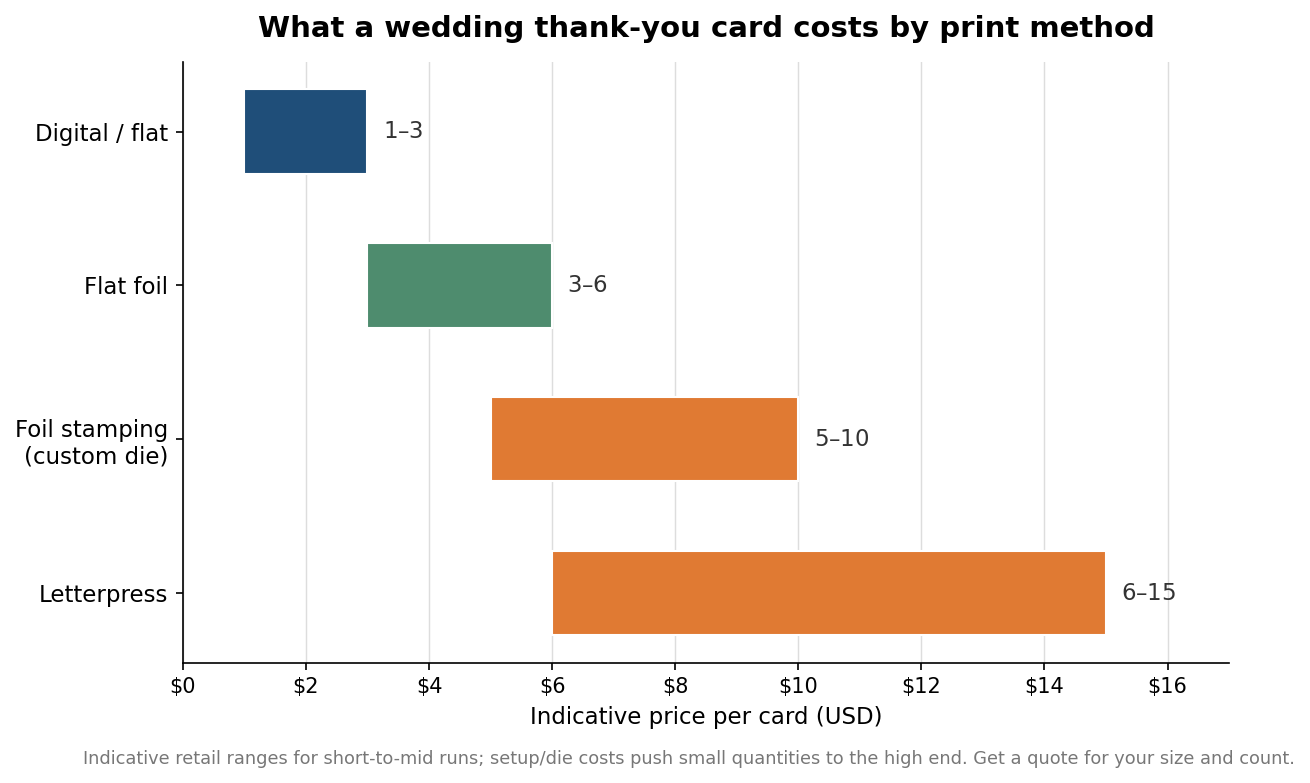
    Method is the biggest lever on cost. Digital or flat printing is the value option and handles full color, gradients, and photography. Flat foil adds a metallic layer without pressing into the paper. Foil stamping presses a custom die into the sheet for a tactile mark, and letterpress debosses the design into thick cotton; both require custom plates or dies and therefore higher minimums and setup fees. The indicative per-card ranges below are for short-to-mid runs, and the setup costs are exactly why small quantities land at the top of each band. Because those fixed costs spread across the run, per-card pricing typically falls 30 to 50 percent moving from a 25-card order up to 150.

    Horizontal range chart of indicative per-card price by print method
    Indicative per-card price ranges by print method for short-to-mid runs.

    The timeline that keeps etiquette on your side

    The clock starts before the wedding. For gifts that arrive ahead of the day, the widely cited standard from The Knot is to send a thank-you within about two weeks of receiving each one. For gifts given at or after the wedding, aim to have your notes out within three months of the wedding date. Waiting longer is not a catastrophe and a late note still lands warmly, but three months is the window that reads as prompt and respectful.

    Order early so the cards are not the bottleneck. The practical move is to have your thank-you cards printed and waiting before the wedding, then write and send them in small batches as gifts come in rather than facing a mountain afterward. That also protects you against print lead times: digital runs often turn in a few business days to a week, while foil and letterpress can take one to three weeks once you factor in proofing. Those windows are indicative and vary by printer and season, so confirm the date in writing when you order.

    Putting the order together

    Work through it in one sitting. Lock your gift-giving household count and add the buffer to get a final quantity. Pick a size and confirm the matching envelope so the two are not ordered separately and mismatched. Choose a print method that fits both the look you want and the budget the quantity implies, remembering that a custom die or letterpress plate only makes sense once the run is large enough to absorb the setup. Proof the return address, any printed message, and the spelling of names on personalized cards before approving, because a typo caught on screen is free and a typo caught in the box is a reprint. Finally, order a handful of spare envelopes; they are cheap, and a smudged envelope should never cost you a whole card.

    Handle those decisions up front and the only hard part left is the writing, which is the part that was always going to take a cup of coffee and a quiet afternoon.

  • What to Write in a Business Thank You Card

    What to Write in a Business Thank You Card

    July 5, 2026 ยท Guides

    The best thank-you notes are short, specific, and sincere. You do not need to be a copywriter โ€” you need to sound like a person.

    A simple formula

    Thank them → be specific → add one warm line → invite them back. Example: “Thank you for your order! We loved packing this one up for you. If you have any questions, just reply — and here’s 10% off your next order: THANKS10.”

    Templates by use

    UseMessage
    Ecommerce insert“Thanks for supporting a small team. Enjoy 10% off next time: CODE.”
    Retail bag“Thank you for shopping with us today — see you again soon!”
    Client gift“Grateful to work with you this year. Here’s to the next.”

    Keep it under three sentences and it will always land.

    Get a quoteReady to print yours? Get a custom quote โ€” proof and pricing within one business day.

    Get a Quote

  • Packaging Inserts That Drive Repeat Orders

    Packaging Inserts That Drive Repeat Orders

    June 21, 2026 ยท Ecommerce

    A packaging insert reaches a customer at the perfect moment: they just received your product and they are happy. The mistake most brands make is cramming too much onto one card.

    One card, one job

    Pick a single call to action per insert — a review request, a referral offer, or a repeat-purchase code — and design the whole card around it. A clear QR code plus one sentence beats a wall of text every time.

    What converts

    GoalInsert element
    ReviewsQR to review page + a nudge
    Repeat ordersA time-limited discount code
    ReferralsA share code with a friend reward

    Rotate the insert seasonally so repeat customers always see something new.

    Get a quoteReady to print yours? Get a custom quote โ€” proof and pricing within one business day.

    Get a Quote

  • Foil vs. Letterpress: Choosing a Premium Finish

    Foil vs. Letterpress: Choosing a Premium Finish

    June 7, 2026 ยท Buyer guides

    Both finishes signal quality, but they create very different impressions — literally.

    Side by side

    FoilLetterpress
    EffectMetallic shine on the surfaceDebossed impression you can feel
    Best onAny premium stockThick cotton stock
    VibeLuxe, celebratoryHandcrafted, timeless

    How to choose

    Choose foil when you want shine and color — gold on a wedding card, rose gold on a beauty brand insert. Choose letterpress when you want texture and craft — a debossed logo on cotton that a client keeps on the desk. And yes, you can combine them for a truly high-end card.

    Get a quoteReady to print yours? Get a custom quote โ€” proof and pricing within one business day.

    Get a Quote