Two thank-you cards can carry the same printed design and feel completely different in the hand, and almost all of that difference is the paper. Weight, coating, and fiber decide whether a card feels like a flyer or like something worth keeping, and they also decide which print finishes are even possible. Here is how card stock actually works, in the terms you will see on a spec sheet.
Cover weight and text weight are not the same number
The single most confusing thing about paper is that the pound number depends on the type of stock. An “80 lb text” and an “80 lb cover” share a number but are entirely different papers: 80 lb text is a foldable sheet in the range of stationery and brochures, while 80 lb cover is a rigid card stock. That happens because a paper’s pound rating is the weight of 500 sheets at that stock’s own basis size, and cover, text, and bond stocks each use a different basis size. For thank-you cards you almost always want cover stock, the card family, not text weight. When a printer lists “80 lb cover” they mean a genuine card; when a supplier advertises a heavy “100 lb” gloss that turns out to be text weight, it will feel far flimsier than a 100 lb cover.
This is why grams per square meter, or gsm, is the less ambiguous unit. Because gsm measures the actual weight of a one-meter-square sheet regardless of stock type, it does not shift meaning between cover and text. If you only remember one habit, ask for the gsm; it removes the pound-rating confusion in one step.
What the weights actually feel like
Card stock for note and greeting cards lives in a fairly narrow band. A 65 lb cover, about 176 gsm, is on the light end and reads more like a postcard or an inner layer of an invitation. An 80 lb cover, about 216 gsm, is the most commonly used card stock and a sensible everyday thank-you card. Step up to 100 lb cover at roughly 270 gsm for a noticeably sturdier feel, 110 lb cover at about 298 gsm for a popular premium weight, and 130 lb cover at around 352 gsm for a heavyweight card that feels substantial before you have printed anything on it. For scale, ordinary copy paper is only about 54 gsm, which is why even an everyday card feels several times more solid than a printout.
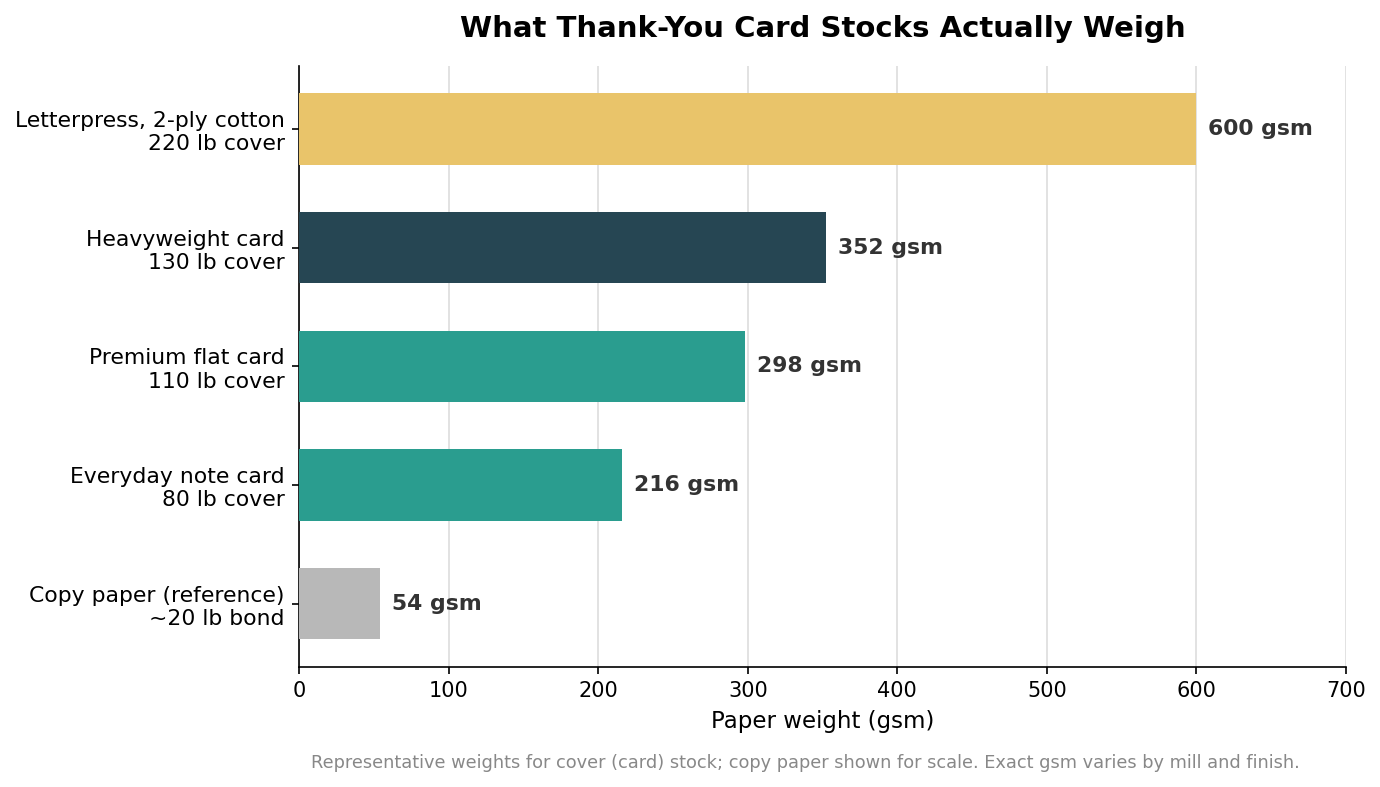
Heavier is not automatically better. Above roughly 300 gsm a single sheet becomes hard to fold cleanly without cracking, which is why folded cards often use a slightly lighter stock and a proper score line while flat cards can go as heavy as you like. The tactile jump buyers notice most is from an everyday 216 gsm to a premium 298 to 352 gsm; past that, weight is more about a specific luxury feel than about everyday quality.
Reading a spec: pounds versus gsm
When you compare quotes, translate everything into gsm so you are comparing the same thing. The common cover-stock conversions are steady: 65 lb is about 176 gsm, 80 lb about 216, 100 lb about 270, 110 lb about 298, and 130 lb about 352. These figures apply to cover stock specifically; run the same pound numbers against text or bond stock and you get different papers entirely, which is exactly the trap the two-weight system sets.
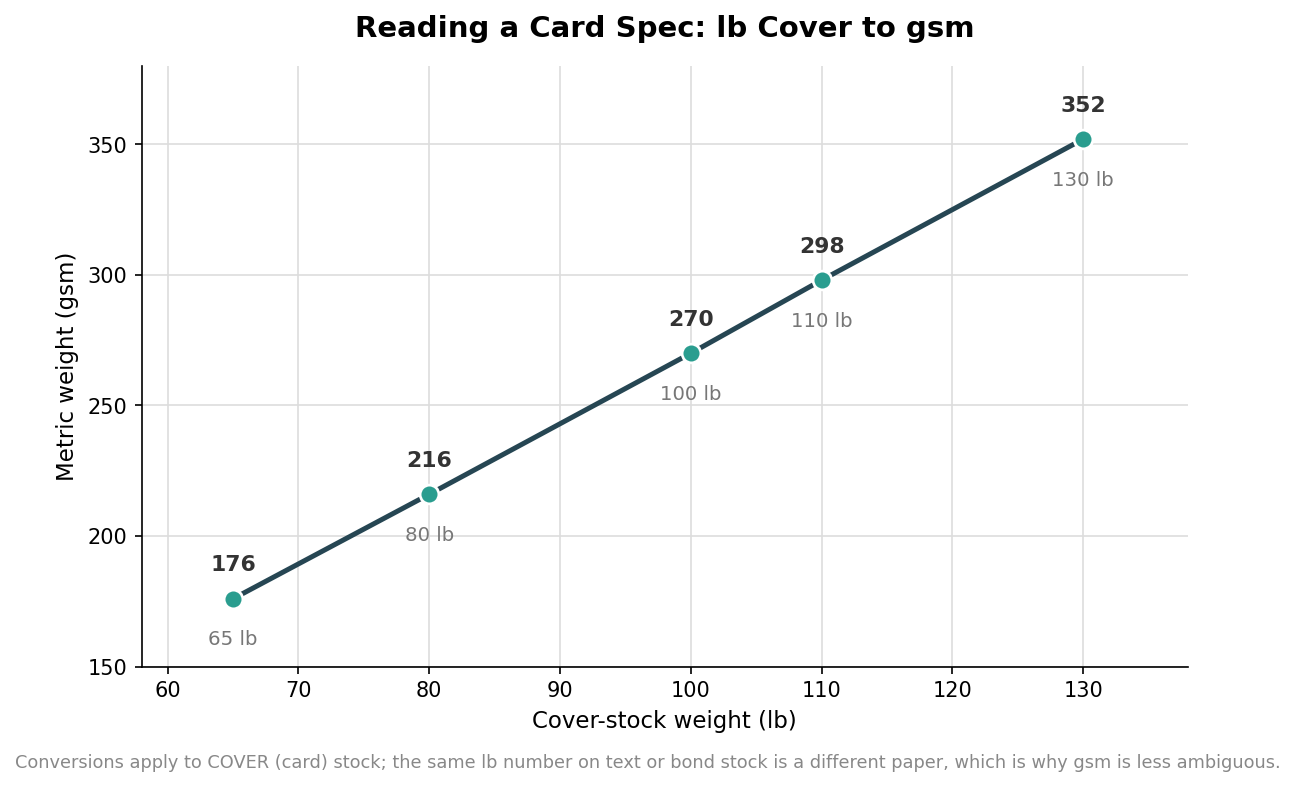
Treat these as close reference points rather than exact constants. Different mills round differently and a given line may run a few grams heavier or lighter, so a spec sheet that lists both the pound rating and the gsm is doing you a favor. If a supplier will only give you a pound number, ask which stock type it refers to before you assume it matches another quote.
Coated or uncoated changes both look and use
Coating is a thin clay layer that makes paper smoother, and it is a genuine fork in the road for thank-you cards. A coated stock, whether gloss, matte, or silk, holds ink on the surface, so colors look more saturated and photographs stay crisp. The trade-off is that a slick coated surface can resist pen ink and smudge, which matters because a thank-you card is often handwritten. An uncoated stock lets ink soak in slightly, giving a warmer, more natural look and, crucially, a surface that takes a pen or a fountain-pen note without beading or smearing. Cotton and other premium uncoated papers push that tactile, letter-quality feel the furthest.
Choose the coating around how the card is used. If the front is a full-bleed photo or a color-heavy brand design and no one will write on it, a coated stock makes the print sing. If recipients will handwrite a message, or you want the understated, textured feel that reads as premium stationery, uncoated is usually the better call. Many cards split the difference by printing a coated exterior for the artwork and leaving an uncoated interior panel for writing.
Match the stock to the finish you want
Print finishes are not universal; each one asks something of the paper. Standard digital and offset printing are the flexible options that run on most coated and uncoated card stocks, which makes them the default for full-color thank-you cards. Foil stamping presses a metallic layer onto the surface and works on coated or uncoated stock, but it wants enough weight underneath to take the pressure cleanly, so it pairs naturally with heavier cards. Letterpress is the most demanding: the deep, tactile impression that defines it needs a soft, thick cotton stock, typically a single-ply around 110 lb or 300 gsm, or two plies duplexed to roughly 220 lb or 600 gsm, in papers like the cotton stocks favored for the craft. Try to letterpress a thin, hard sheet and the impression will not hold.
Start from the gsm, decide coated or uncoated by whether the card will be written on, and confirm the stock can carry the finish you are paying for. Get those three right and a thank-you card feels considered the moment someone picks it up, which is the entire point of sending one.
Leave a Reply