A custom thank-you card looks like a simple print job, but a handful of specifications decide whether it drops cleanly into its envelope, clears the post office at the standard rate, and takes a handwritten note without the ink feathering. Getting those numbers right before you approve artwork is what saves a reprint. This walkthrough covers the decisions in the order you should make them: size, fold, envelope, stock, and file setup.
Card size sets up every decision after it
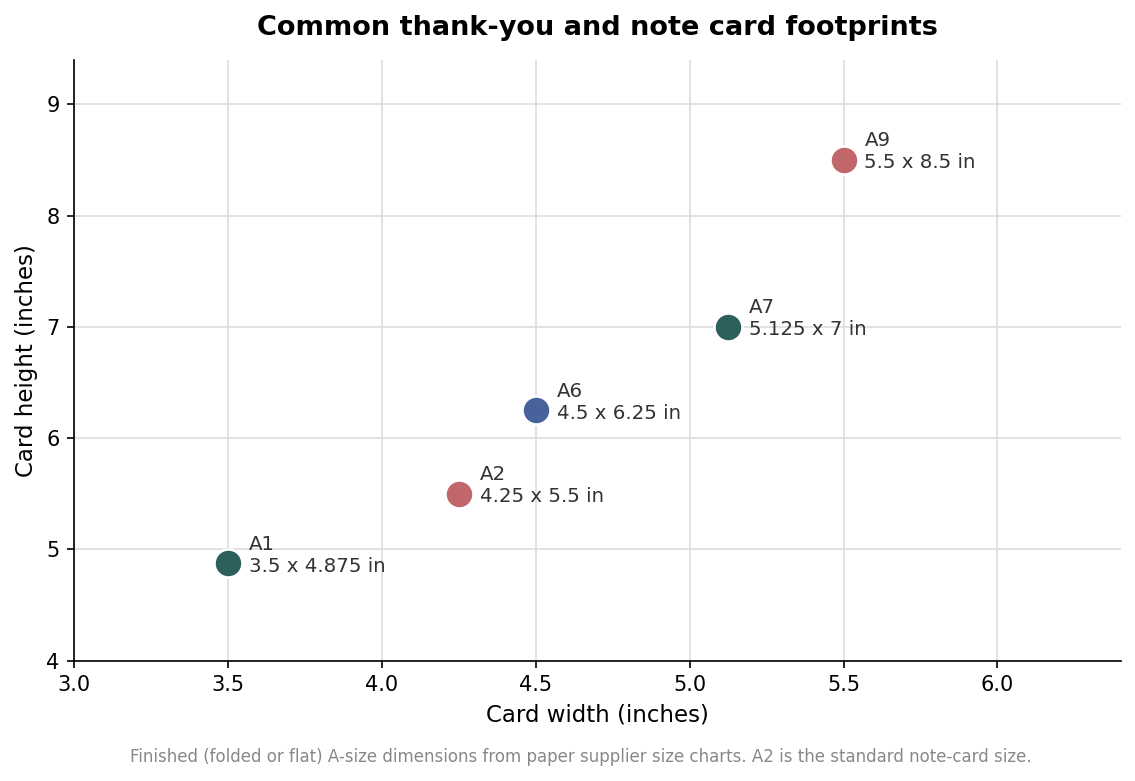
Thank-you and note cards mostly follow the A-size system, and the finished dimensions are worth committing to memory because they cascade into envelope choice and postage. The A2, at 4 1/4 by 5 1/2 inches, is the default note-card size and the one most people picture when they think “thank-you card.” Step down to the A1 at 3 1/2 by 4 7/8 inches for a compact enclosure or an RSVP, or up to the A6 at 4 1/2 by 6 1/4 inches when you want more writing room. The A7, at 5 1/8 by 7 inches, is the popular five-by-seven format used for larger cards and invitations, and the A9 at 5 1/2 by 8 1/2 inches is about as big as a card gets before mailing rules start to complicate things. These finished dimensions apply whether the card is flat or folded.
Flat or folded changes the file, not just the feel
A folded card is physically a larger sheet. A folded A2 that finishes at 4 1/4 by 5 1/2 inches is printed on a flat sheet of 8 1/2 by 5 1/2 inches and scored down the middle, which means the print file has to be built at the unfolded size with a score line marked, not at the finished size. Flat cards are simpler: a single panel printed on one or both sides, ideal for postcards and for high-volume business thank-yous where you want a printable back for a message or a mailing panel. Decide this early, because it sets how many printable panels you are designing, two for a flat card and up to four for a folded one, and how the artwork is imposed on the press sheet. Folded cards also stand on their own on a desk or mantel, which some recipients like, while flat cards mail more cheaply and photograph better for a brand that reuses the shot in marketing.
Match the envelope, then check the mail
Every A-size card has a matching A-size envelope cut roughly an eighth to a quarter inch larger on each dimension so the card slides in without forcing. An A2 card pairs with an A2 envelope at 4 3/8 by 5 3/4 inches; an A7 card with an A7 envelope at 5 1/4 by 7 1/4 inches. Order the envelope alongside the card rather than sourcing it separately, since a near-miss on size is the most common reason a good-looking card arrives creased. Then sanity-check the mailing rules. A standard letter-size piece runs from a minimum of 3 1/2 by 5 inches to a maximum of 6 1/8 by 11 1/2 inches and must be at least 0.007 inch thick, so all of the A sizes qualify. The trap is shape: square envelopes and rigid or extra-thick pieces are treated as nonmachinable and carry a surcharge on top of regular postage. If you love the look of a square card, budget for that added cost per piece and take a fully assembled sample to the post office to confirm the rate before buying stamps in bulk.
Paper weight and finish decide how it writes
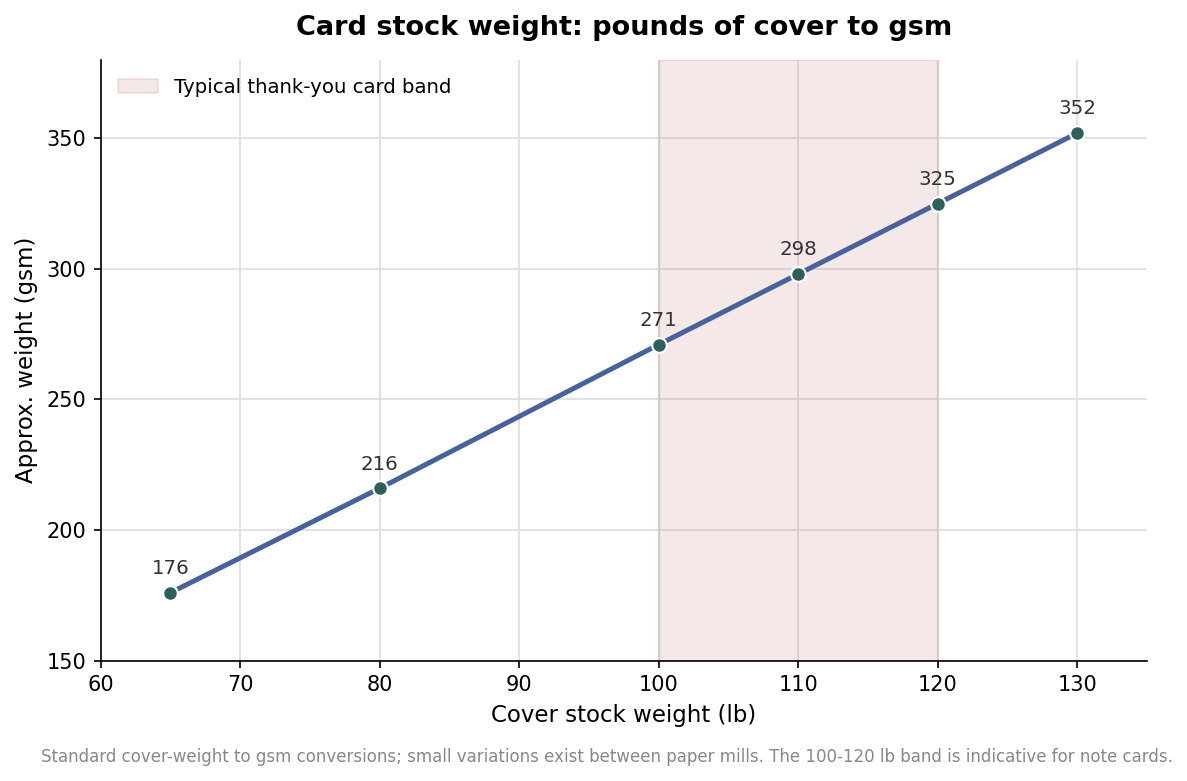
Card stock is sold by weight, and the two systems you will encounter are pounds of cover stock and grams per square meter. For thank-you cards the useful band sits around 100 to 120 pound cover, which is roughly 271 to 325 gsm; that range feels substantial in the hand without being so thick that it resists folding or cracks at the score. Lighter 80 pound cover, about 216 gsm, works for inexpensive high-volume cards, while heavier luxe stocks climb past 130 pound cover, near 352 gsm, for a premium flat card that will never be folded. Postcards are often quoted in points of thickness instead, commonly 14 to 16 point. Finish matters as much as weight when the card will be written on: an uncoated stock accepts pen ink and absorbs it cleanly, while a glossy coated surface can smear or bead, so reserve coatings for cards that are printed-only and choose uncoated whenever a handwritten message is the whole point. If you want the tactile signal of quality without giving up writability, a soft-touch or matte-coated front paired with an uncoated writing panel inside a folded card is a common compromise.
Set up the file so the proof matches the print
Two setup habits prevent most disappointments. Add a bleed of one-eighth inch on every edge if color or artwork runs to the trim, so a slight shift on the cutter does not leave a white sliver, and keep important text and logos at least an eighth to a quarter inch inside the trim line in the safe area, since anything closer risks being clipped. Build the file at the correct flat size for your fold, export at 300 dpi, and then ask for a proof, ideally a physical one on the actual stock. Uncoated paper in particular renders color softer and a touch darker than a screen suggests, and a proof is the cheapest place to catch that before a full run commits. Settle size, fold, envelope, stock, and setup in that order and the finished thank-you card behaves exactly the way you designed it to.
Leave a Reply