Author: George

  • How to Spec a Custom Thank-You Card: Sizes, Envelopes, and Paper Weight

    How to Spec a Custom Thank-You Card: Sizes, Envelopes, and Paper Weight

    A custom thank-you card looks like a simple print job, but a handful of specifications decide whether it drops cleanly into its envelope, clears the post office at the standard rate, and takes a handwritten note without the ink feathering. Getting those numbers right before you approve artwork is what saves a reprint. This walkthrough covers the decisions in the order you should make them: size, fold, envelope, stock, and file setup.

    Card size sets up every decision after it

    Thank-you and note cards mostly follow the A-size system, and the finished dimensions are worth committing to memory because they cascade into envelope choice and postage. The A2, at 4 1/4 by 5 1/2 inches, is the default note-card size and the one most people picture when they think “thank-you card.” Step down to the A1 at 3 1/2 by 4 7/8 inches for a compact enclosure or an RSVP, or up to the A6 at 4 1/2 by 6 1/4 inches when you want more writing room. The A7, at 5 1/8 by 7 inches, is the popular five-by-seven format used for larger cards and invitations, and the A9 at 5 1/2 by 8 1/2 inches is about as big as a card gets before mailing rules start to complicate things. These finished dimensions apply whether the card is flat or folded.
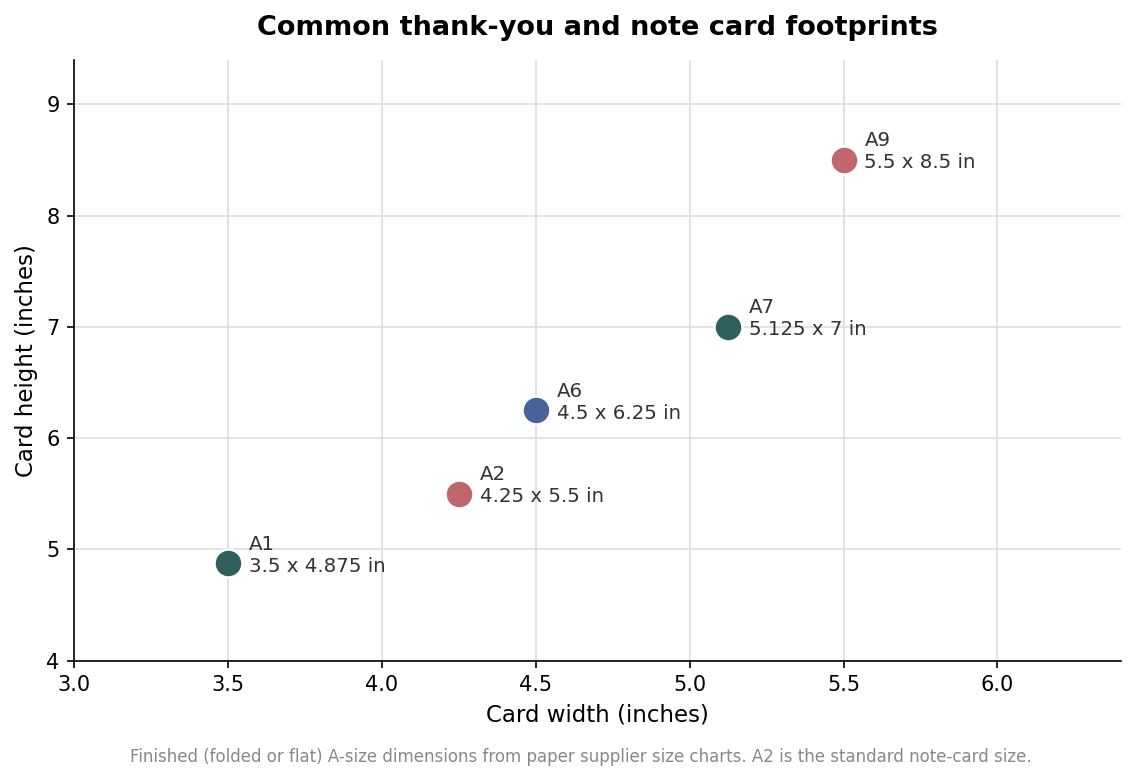
    Scatter chart plotting width against height for A1, A2, A6, A7, and A9 card sizes in inches
    The A2 at 4.25 by 5.5 inches is the standard note-card size; A7 and A9 give more room but approach mailing limits.

    Flat or folded changes the file, not just the feel

    A folded card is physically a larger sheet. A folded A2 that finishes at 4 1/4 by 5 1/2 inches is printed on a flat sheet of 8 1/2 by 5 1/2 inches and scored down the middle, which means the print file has to be built at the unfolded size with a score line marked, not at the finished size. Flat cards are simpler: a single panel printed on one or both sides, ideal for postcards and for high-volume business thank-yous where you want a printable back for a message or a mailing panel. Decide this early, because it sets how many printable panels you are designing, two for a flat card and up to four for a folded one, and how the artwork is imposed on the press sheet. Folded cards also stand on their own on a desk or mantel, which some recipients like, while flat cards mail more cheaply and photograph better for a brand that reuses the shot in marketing.

    Match the envelope, then check the mail

    Every A-size card has a matching A-size envelope cut roughly an eighth to a quarter inch larger on each dimension so the card slides in without forcing. An A2 card pairs with an A2 envelope at 4 3/8 by 5 3/4 inches; an A7 card with an A7 envelope at 5 1/4 by 7 1/4 inches. Order the envelope alongside the card rather than sourcing it separately, since a near-miss on size is the most common reason a good-looking card arrives creased. Then sanity-check the mailing rules. A standard letter-size piece runs from a minimum of 3 1/2 by 5 inches to a maximum of 6 1/8 by 11 1/2 inches and must be at least 0.007 inch thick, so all of the A sizes qualify. The trap is shape: square envelopes and rigid or extra-thick pieces are treated as nonmachinable and carry a surcharge on top of regular postage. If you love the look of a square card, budget for that added cost per piece and take a fully assembled sample to the post office to confirm the rate before buying stamps in bulk.

    Paper weight and finish decide how it writes

    Card stock is sold by weight, and the two systems you will encounter are pounds of cover stock and grams per square meter. For thank-you cards the useful band sits around 100 to 120 pound cover, which is roughly 271 to 325 gsm; that range feels substantial in the hand without being so thick that it resists folding or cracks at the score. Lighter 80 pound cover, about 216 gsm, works for inexpensive high-volume cards, while heavier luxe stocks climb past 130 pound cover, near 352 gsm, for a premium flat card that will never be folded. Postcards are often quoted in points of thickness instead, commonly 14 to 16 point. Finish matters as much as weight when the card will be written on: an uncoated stock accepts pen ink and absorbs it cleanly, while a glossy coated surface can smear or bead, so reserve coatings for cards that are printed-only and choose uncoated whenever a handwritten message is the whole point. If you want the tactile signal of quality without giving up writability, a soft-touch or matte-coated front paired with an uncoated writing panel inside a folded card is a common compromise.
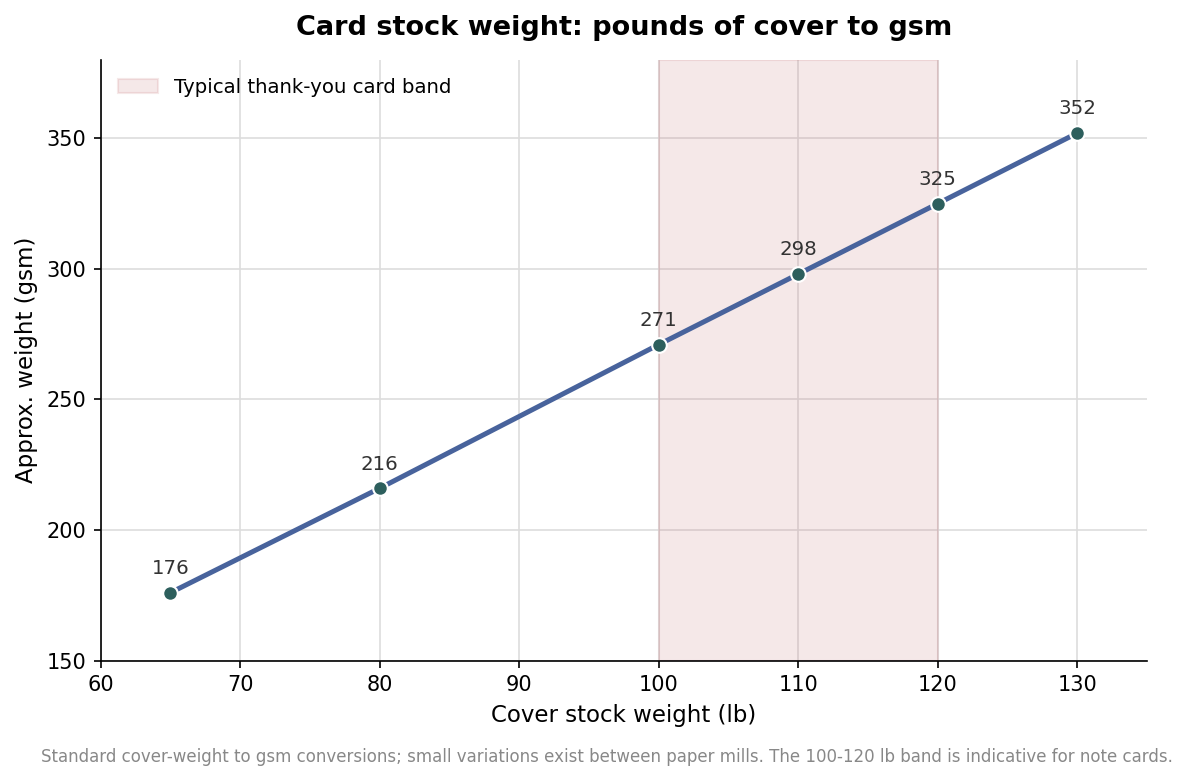
    Line chart converting cover stock weight in pounds to gsm, with the 100 to 120 pound thank-you card range highlighted
    Most thank-you cards land around 100 to 120 pound cover, about 271 to 325 gsm.

    Set up the file so the proof matches the print

    Two setup habits prevent most disappointments. Add a bleed of one-eighth inch on every edge if color or artwork runs to the trim, so a slight shift on the cutter does not leave a white sliver, and keep important text and logos at least an eighth to a quarter inch inside the trim line in the safe area, since anything closer risks being clipped. Build the file at the correct flat size for your fold, export at 300 dpi, and then ask for a proof, ideally a physical one on the actual stock. Uncoated paper in particular renders color softer and a touch darker than a screen suggests, and a proof is the cheapest place to catch that before a full run commits. Settle size, fold, envelope, stock, and setup in that order and the finished thank-you card behaves exactly the way you designed it to.
  • Wedding Thank-You Cards: How Many to Order, Sizes, and Timing

    Wedding Thank-You Cards: How Many to Order, Sizes, and Timing

    The wedding is over, the gifts are logged, and now a stack of thank-you cards is the last thing standing between you and the finish line. The notes themselves take patience, but the ordering decisions in front of them are quick once you know what actually drives the choices: how many to buy, what size to send, which print method fits your budget, and when everything has to be in the mail. Here is how to settle each of those before you place the order.

    Order by household, not by headcount

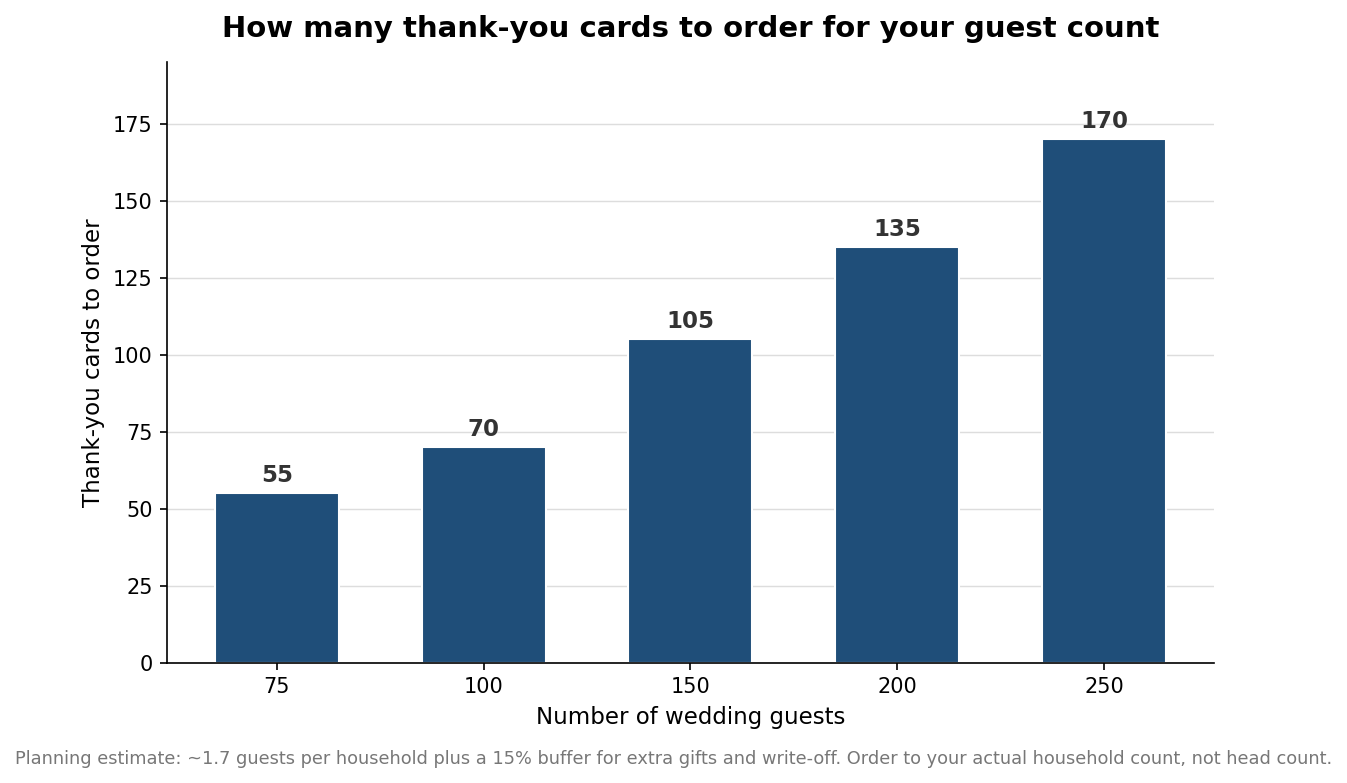
    The single most common mistake is ordering one card per guest. You are not thanking people, you are thanking gifts, and gifts arrive by household. A couple who attends together and gives one gift gets one note. In practice that means your card count tracks the number of invitations that produced a gift, not the number of place settings at the reception. A useful planning ratio is roughly 1.7 guests per household, so a 150-guest wedding generates somewhere near 88 gift-giving households.

    Then add a buffer of 10 to 15 percent. You will spoil a few cards mid-sentence, you will want a keepsake or two, and gifts have a way of arriving from people who never made it to the wedding. Shower and engagement-party gifts complicate the math further, because etiquette treats each gift as its own thank-you even when the same person gave all three. If you hosted pre-wedding events, order extra rather than reprinting a small second batch at a higher per-card cost. The chart below shows a reasonable starting quantity for common guest counts.

    Bar chart of recommended wedding thank-you card order quantity by guest count
    A starting quantity by guest count, based on households plus a buffer.

    Sizes, formats, and envelopes that fit together

    Two sizes dominate the category. The A2 card measures 4.25 by 5.5 inches and pairs with an A2 envelope of about 4.375 by 5.75 inches; it prints and mails cheaply and reads as a classic note card. The 5 by 7 card, which takes an A7 envelope of about 5.25 by 7.25 inches, gives you far more room for a photo or a longer printed message and delivers a more substantial in-hand feel, at a slightly higher paper and postage cost. A flat 4 by 6 postcard-style card is a third route that skips the envelope entirely and can qualify for postcard postage, which adds up across a couple hundred pieces.

    Folded or flat is partly practical. A folded card hides your handwriting until it is opened and gives you a blank interior to write on, which most couples prefer for a heartfelt note. Flat cards suit photo thank-yous, where the front carries a wedding image and the back holds a short printed line plus a couple of handwritten sentences. If you are including a photo, confirm the printer’s bleed and safe-area margins so faces do not get trimmed at the edge.

    Paper stock and print method set the feel and the price

    Weight is what people notice first. Digitally printed thank-you cards are commonly produced on 110 to 130 lb cover stock, roughly 300 gsm, which is sturdy without being showy. Letterpress and heavy foil work want a thicker sheet, typically 300 gsm cotton or a double-thick 600 gsm cotton that holds a deep impression. Heavier stock costs more per sheet and can nudge you into a higher postage tier, so weigh a finished sample before you assume standard rates.

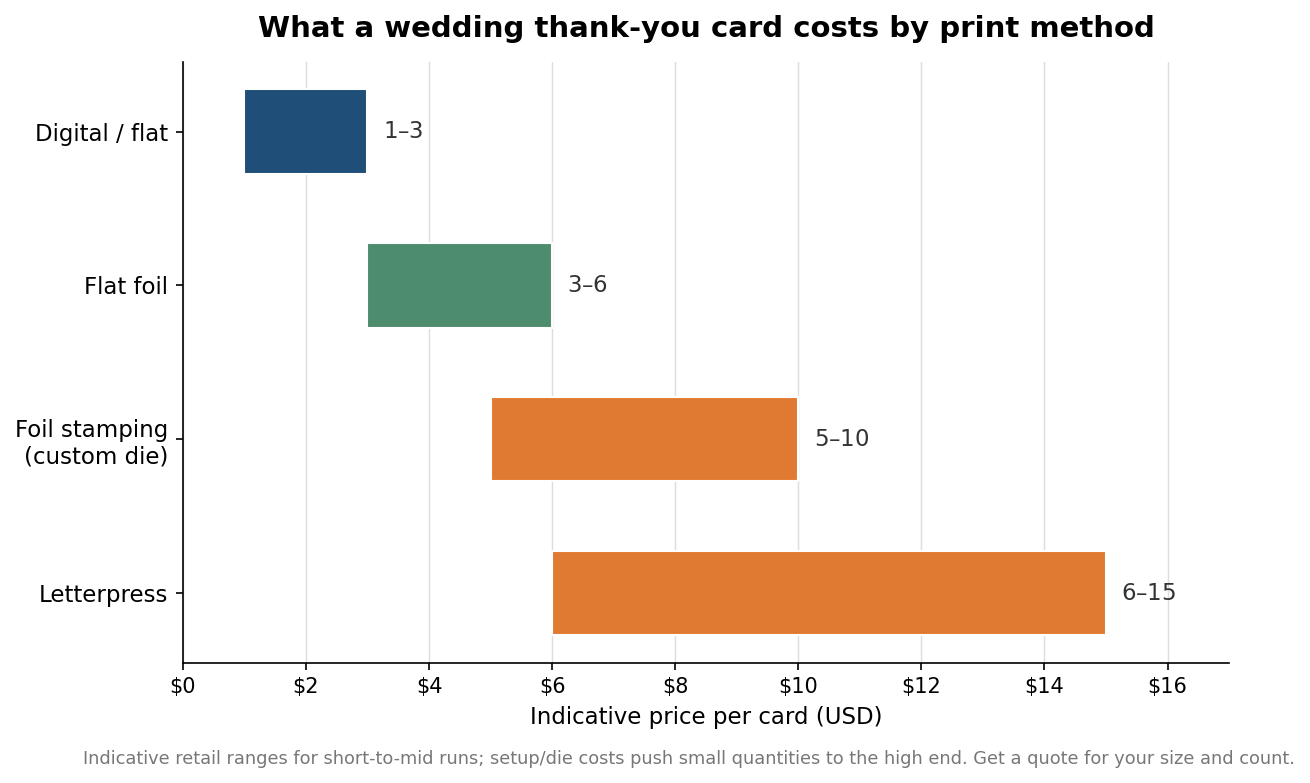
    Method is the biggest lever on cost. Digital or flat printing is the value option and handles full color, gradients, and photography. Flat foil adds a metallic layer without pressing into the paper. Foil stamping presses a custom die into the sheet for a tactile mark, and letterpress debosses the design into thick cotton; both require custom plates or dies and therefore higher minimums and setup fees. The indicative per-card ranges below are for short-to-mid runs, and the setup costs are exactly why small quantities land at the top of each band. Because those fixed costs spread across the run, per-card pricing typically falls 30 to 50 percent moving from a 25-card order up to 150.

    Horizontal range chart of indicative per-card price by print method
    Indicative per-card price ranges by print method for short-to-mid runs.

    The timeline that keeps etiquette on your side

    The clock starts before the wedding. For gifts that arrive ahead of the day, the widely cited standard from The Knot is to send a thank-you within about two weeks of receiving each one. For gifts given at or after the wedding, aim to have your notes out within three months of the wedding date. Waiting longer is not a catastrophe and a late note still lands warmly, but three months is the window that reads as prompt and respectful.

    Order early so the cards are not the bottleneck. The practical move is to have your thank-you cards printed and waiting before the wedding, then write and send them in small batches as gifts come in rather than facing a mountain afterward. That also protects you against print lead times: digital runs often turn in a few business days to a week, while foil and letterpress can take one to three weeks once you factor in proofing. Those windows are indicative and vary by printer and season, so confirm the date in writing when you order.

    Putting the order together

    Work through it in one sitting. Lock your gift-giving household count and add the buffer to get a final quantity. Pick a size and confirm the matching envelope so the two are not ordered separately and mismatched. Choose a print method that fits both the look you want and the budget the quantity implies, remembering that a custom die or letterpress plate only makes sense once the run is large enough to absorb the setup. Proof the return address, any printed message, and the spelling of names on personalized cards before approving, because a typo caught on screen is free and a typo caught in the box is a reprint. Finally, order a handful of spare envelopes; they are cheap, and a smudged envelope should never cost you a whole card.

    Handle those decisions up front and the only hard part left is the writing, which is the part that was always going to take a cup of coffee and a quiet afternoon.

  • How to Choose Custom Thank-You Cards for Your Brand

    How to Choose Custom Thank-You Cards for Your Brand

    How to Choose Custom Thank-You Cards for Your Brand: Use Cases and Ordering

    The best way to choose custom thank-you cards is to start from how they will be used, then work back to the material, size, and decoration that fit. Custom thank-you cards serve very different jobs across food service, e-commerce inserts, retail & branding, and events, and matching the order to the job is what makes custom thank-you cards feel purpose-built rather than generic. This guide maps the common use cases and walks through ordering custom thank-you cards that fit your brand.

    Whether the thank-you cards protects a product, presents a gift, or carries a logo into the world, defining that job first keeps every later decision easy. Purpose drives the spec, and the spec drives the result.

    How brands use custom thank-you cards

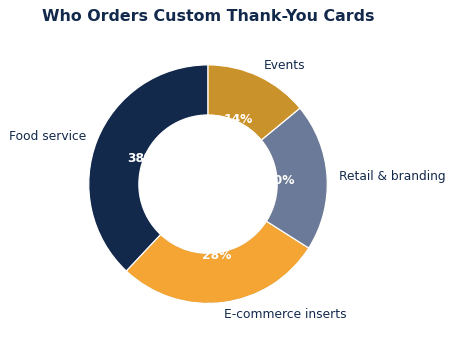
    Custom thank-you cards get ordered for a mix of protection, presentation, and promotion, and knowing where yours fall points you to the right build. The breakdown below shows the common uses, from food service to events.

    The common ways brands put custom thank-you cards to work.
    The common ways brands put custom thank-you cards to work.

    Most orders lean toward one primary job with a secondary benefit — a shipping-focused thank-you cards that also brands the unboxing, or a gift-focused one that also protects. Naming your primary use keeps the order focused and the spec appropriate.

    Use case What it needs
    Food service branded, food-safe paper that dresses up a serve
    E-commerce inserts thank-you and instruction cards that build loyalty
    Retail & branding labels and wraps that reinforce the brand
    Events printed pieces that tie a theme together

    Matching material and size to the use

    Once the use is clear, the material and size follow. A protection-first job favors a durable, well-fitted build; a presentation-first job favors a premium material and a clean print; a promotion-first job favors a cost-effective option you can order in volume. Sizing to the product with a small margin keeps the thank-you cards looking intentional and performing its job.

    If a single order serves more than one use, spec to the most demanding one so the thank-you cards performs everywhere. It is easier to use a slightly sturdier or more premium thank-you cards across the board than to discover a bargain option falls short for your most important use case.

    Branding for the impression you want

    Decoration should reinforce the impression the use calls for. Digital and offset printing reproduce full-color art crisply, with spot colors and foil available for a premium touch. For a premium or gift use, lean on finishes and restraint; for high-volume promotion, prioritize a bold, legible logo that reads at a glance and reproduces affordably at scale. Keep branding consistent with the rest of your packaging or merch so everything reads as one system.

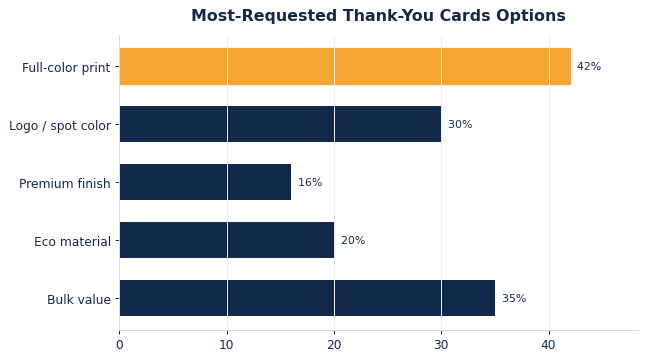
    The most-requested options below reflect what buyers reach for most, and they are a useful starting menu when you brief your order. Whatever you choose, approve a proof so the finished custom thank-you cards match the impression you intended.

    The options buyers request most on custom thank-you cards.
    The options buyers request most on custom thank-you cards.

    Getting the size and details right

    Even with the use and material decided, the details are what make custom thank-you cards feel finished. Confirm the size and weight against the product with a small margin, check the print area for your chosen size so the logo sits cleanly, and decide on any finishing touches before you brief the order. These small confirmations up front are what separate a thank-you cards that looks intentional from one that looks close-enough.

    A sample or proof is the cheapest insurance you can buy on a thank-you cards order. A physical sample lets you judge the material and print in hand, while a digital proof confirms artwork, color, and size and weight before the full run. Spending a few minutes here prevents the far larger cost of reworking a finished order of custom thank-you cards that missed on a detail.

    Ordering: quantities, lead time, and reorders

    A smooth thank-you cards order comes down to a few basics: order for real demand plus a small overage, send print-ready artwork early, and confirm lead time against any deadline so production and shipping fit your timeline. Per-unit cost drops with volume, so consolidating a season’s needs into one run is usually more efficient than repeated small orders.

    Keep your approved artwork and spec on file so reorders are a quick repeat rather than a fresh setup each time — consistency across runs keeps your brand looking deliberate.

    Coordinating with the rest of your brand

    Custom thank-you cards rarely stand alone; they sit alongside your other packaging, print, or merch, so coordinating them strengthens the whole brand. Carrying the same logo, colors, and tone across your thank-you cards and your other pieces makes everything read as one deliberate system rather than a set of one-off orders. That consistency is what makes a brand feel established, and it costs nothing extra to plan.

    Coordination also simplifies buying over time. Standardizing on a material, size, and decoration you are happy with turns future orders into simple repeats, and it keeps every batch matching the last. A little upfront alignment pays back every time you reorder custom thank-you cards.

    Frequently asked questions about custom thank-you cards

    What are custom thank-you cards used for?

    Custom thank-you cards serve a mix of protection, presentation, and promotion across food service, e-commerce inserts, retail & branding, and events. Most orders lean toward one primary job with a secondary benefit, so naming your main use is the first step in speccing the right thank-you cards.

    How do I match custom thank-you cards to my use?

    Let the use drive the spec: durable and well-fitted for protection, premium and clean for presentation, cost-effective and bold for promotion. If one order serves several uses, spec to the most demanding one so the thank-you cards performs everywhere.

    How should I brand custom thank-you cards?

    Digital and offset printing reproduce full-color art crisply, with spot colors and foil available for a premium touch. Choose finishes and restraint for premium or gift uses, and a bold, legible logo for high-volume promotion, keeping the branding consistent with your other packaging or merch so it all reads as one system.

    How far ahead should I order custom thank-you cards?

    Order for real demand plus a small overage, send print-ready artwork early, and confirm lead time against any deadline so production and shipping fit your timeline. Consolidating a season’s needs into one run is usually more efficient than repeated small orders.

    Can I reorder easily?

    Yes. Keeping your approved artwork and spec on file makes reorders a quick repeat rather than a fresh setup, and it keeps every batch of custom thank-you cards matching the last for a consistent brand look.

    Do I need a sample before ordering custom thank-you cards?

    A sample is worth it for a first order or a new material, since judging feel and print in hand removes the guesswork. For a straightforward reorder of custom thank-you cards you have bought before, a digital proof confirming artwork and size and weight is usually enough.

    Match the thank-you cards to the job, spec it deliberately, and approve a proof, and your order will do exactly what you needed. For the full material and sizing breakdown, see our companion guide, our Custom Thank-You Cards: Materials, Sizing & Branding Guide, and browse our our shop to get started.

    Not sure which custom thank-you cards fit your use?

    Tell us how you’ll use them and we’ll match the material, size, and branding to the job.

    Get a Quote

  • Custom Thank-You Cards: Materials, Sizing & Branding Guide

    Custom Thank-You Cards: Materials, Sizing & Branding Guide

    Custom Thank-You Cards: A Materials, Sizing, and Branding Guide

    Getting custom thank-you cards right comes down to three decisions: the material, the size or spec, and how you brand them. Make those well and you end up with custom thank-you cards that protect and present your product, reinforce your brand, and land on budget. This guide walks through the material options, how to size and spec your order, and how to decorate custom thank-you cards so they do real work for your brand rather than just checking a box.

    Whether you are ordering your first run or reordering at scale, the same fundamentals apply. Choosing custom thank-you cards deliberately — material to job, size to product, decoration to brand — is what separates an order you are proud of from one you settle for.

    Why custom thank-you cards matter for your brand

    Custom thank-you cards are more than a commodity; they are a touchpoint brands experience directly. A well-chosen, well-branded option signals quality and attention to detail, while a generic one quietly undercuts an otherwise strong product. Because custom thank-you cards are seen and handled, they carry your brand into the world every time they are used.

    That visibility is exactly why it pays to spec custom thank-you cards intentionally. The material sets the feel, the size sets the fit and cost, and the decoration sets the impression — and getting all three aligned turns a functional item into a genuine brand asset.

    Materials and options compared

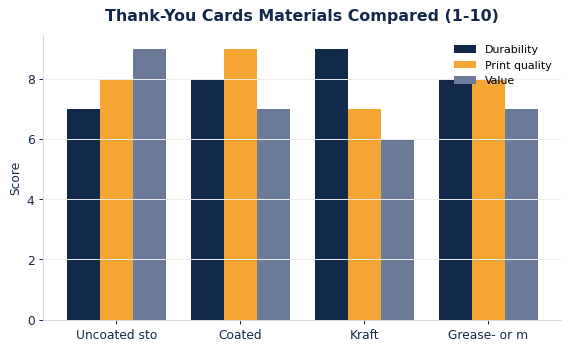
    The common materials for custom thank-you cards each trade off durability, print quality, and cost: uncoated stock, coated / gloss stock, kraft / recycled, and grease- or moisture-resistant. The right pick depends on how the thank-you cards will be used, the look you want, and your budget. The chart and table below compare the main options so you can match material to job.

    How common thank-you cards materials compare on durability, print quality, and value.
    How common thank-you cards materials compare on durability, print quality, and value.

    As a rule of thumb, choose a recyclable or natural material when eco positioning matters, a coated or laminated option when you want vivid full-color print, and a premium build when the thank-you cards is part of a gift or high-end presentation. When in doubt, request a sample so you can judge feel and print before committing to a full run.

    Material / option Best for
    Uncoated stock natural, writable surface with a matte look
    Coated / gloss stock vivid color and a polished finish
    Kraft / recycled eco-forward, warm natural tone
    Grease- or moisture-resistant food-safe performance where needed

    Sizing and specs

    Sizing is where many thank-you cards orders go wrong, so measure before you order. Custom thank-you cards typically range from a small insert card up to a full wrap or liner sheet, and the right size and weight depends on the product or use they serve. Too small and the fit is tight or the product is exposed; too large and you pay for material you do not need and lose a clean, intentional look.

    When a measurement falls between standard options, size to the product with a small margin rather than guessing. Confirming the size and weight on a proof or sample before a large run prevents the costly mistake of a full order that does not fit, which is far more expensive to fix than a five-minute check up front.

    Branding and decoration

    Decoration is what turns a plain thank-you cards into a branded one. Digital and offset printing reproduce full-color art crisply, with spot colors and foil available for a premium touch. Match the method to your artwork and budget: simple logos reproduce cleanly and cheaply, while detailed, full-color designs shine with the right process on the right material. Keep the artwork vector where possible and confirm the print area for your chosen size.

    Restraint usually reads as premium. A clean logo, one or two brand colors, and quality material almost always look more considered than a busy, over-printed design. Approving a proof before the run protects both the look and the budget, especially on a large order of custom thank-you cards.

    Ordering and budget

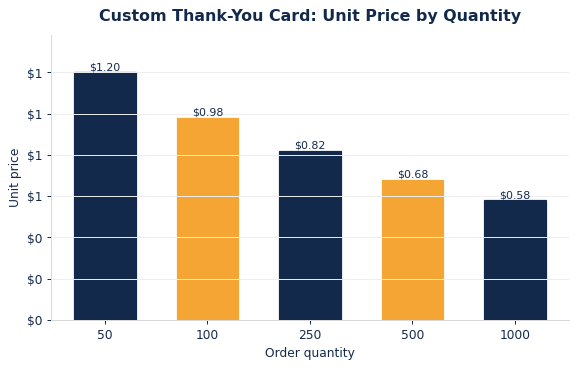
    Per-unit cost on custom thank-you cards falls steadily with volume as setup amortizes across more pieces, so ordering for real demand rather than a token first batch is usually the efficient move. The curve below shows how pricing typically improves with quantity, which helps you plan an order that balances cash and cost.

    Typical per-unit thank-you cards pricing as order quantity increases.
    Typical per-unit thank-you cards pricing as order quantity increases.
    Ordering for a recurring need? A single larger run lowers the unit cost and keeps your branding consistent, while a small overage covers reorders and the occasional damaged piece without a rush order.

    Common mistakes to avoid

    A few avoidable missteps account for most disappointing thank-you cards orders. Ordering before measuring is the biggest, followed by choosing a material for price alone without considering how the thank-you cards will actually be used, and skipping the proof on a large run. Each is easy to prevent with a few minutes of planning, and each is expensive to fix once a full order is produced.

    The other common trap is over-designing the artwork. Cramming in too many colors, effects, or details can muddy the print and raise the cost, especially on textured or recycled materials. Simplifying the design to a clean, legible mark almost always improves both the look and the price of your custom thank-you cards.

    Frequently asked questions about custom thank-you cards

    What material is best for custom thank-you cards?

    It depends on the use: choose a recyclable or natural material for eco positioning, a coated or laminated option for vivid full-color print, and a premium build for gifting or high-end presentation. Request a sample to judge feel and print before a full run of custom thank-you cards.

    How do I choose the right size?

    Measure the product or use the thank-you cards serves, then size to it with a small margin so the fit is clean without wasting material. When a measurement falls between standard options, size up slightly and confirm the size and weight on a proof before ordering in volume.

    How are custom thank-you cards branded?

    Digital and offset printing reproduce full-color art crisply, with spot colors and foil available for a premium touch. Match the method to your artwork and budget, keep the art vector where possible, confirm the print area for your size, and approve a proof so the finished custom thank-you cards match your intent.

    How does pricing work, and is there a minimum?

    Per-unit cost drops with quantity as setup amortizes across the run, so larger orders are more cost-effective. Order for real demand plus a small overage rather than a token batch, and consolidate recurring needs into one run for the best price.

    Can I get a sample or proof before ordering?

    Yes, and it is strongly recommended. A physical sample lets you judge material and print, and a digital or physical proof confirms your artwork, color, and size and weight before a full run — a small step that prevents a costly mistake on a large order.

    What do you need to quote custom thank-you cards?

    To quote accurately we need the size and weight or the product they serve, the quantity, your material preference, and your artwork or a description of the branding. With those details we can recommend the right material and size and give you pricing for the run, and a proof follows once the order is confirmed.

    Whatever you order, send vector artwork, confirm material and size and weight, and approve a proof before production. For help matching custom thank-you cards to a specific use, see our companion guide, our How to Choose Custom Thank-You Cards for Your Brand, and explore our our shop to start your order.

    Ready to order custom thank-you cards?

    Tell us your product, quantity, and branding and we’ll match the material, size, and decoration for you.

    Get a Quote

  • What to Write in a Business Thank You Card

    What to Write in a Business Thank You Card

    July 5, 2026 ยท Guides

    The best thank-you notes are short, specific, and sincere. You do not need to be a copywriter โ€” you need to sound like a person.

    A simple formula

    Thank them → be specific → add one warm line → invite them back. Example: “Thank you for your order! We loved packing this one up for you. If you have any questions, just reply — and here’s 10% off your next order: THANKS10.”

    Templates by use

    UseMessage
    Ecommerce insert“Thanks for supporting a small team. Enjoy 10% off next time: CODE.”
    Retail bag“Thank you for shopping with us today — see you again soon!”
    Client gift“Grateful to work with you this year. Here’s to the next.”

    Keep it under three sentences and it will always land.

    Get a quoteReady to print yours? Get a custom quote โ€” proof and pricing within one business day.

    Get a Quote

  • Packaging Inserts That Drive Repeat Orders

    Packaging Inserts That Drive Repeat Orders

    June 21, 2026 ยท Ecommerce

    A packaging insert reaches a customer at the perfect moment: they just received your product and they are happy. The mistake most brands make is cramming too much onto one card.

    One card, one job

    Pick a single call to action per insert — a review request, a referral offer, or a repeat-purchase code — and design the whole card around it. A clear QR code plus one sentence beats a wall of text every time.

    What converts

    GoalInsert element
    ReviewsQR to review page + a nudge
    Repeat ordersA time-limited discount code
    ReferralsA share code with a friend reward

    Rotate the insert seasonally so repeat customers always see something new.

    Get a quoteReady to print yours? Get a custom quote โ€” proof and pricing within one business day.

    Get a Quote

  • Foil vs. Letterpress: Choosing a Premium Finish

    Foil vs. Letterpress: Choosing a Premium Finish

    June 7, 2026 ยท Buyer guides

    Both finishes signal quality, but they create very different impressions — literally.

    Side by side

    FoilLetterpress
    EffectMetallic shine on the surfaceDebossed impression you can feel
    Best onAny premium stockThick cotton stock
    VibeLuxe, celebratoryHandcrafted, timeless

    How to choose

    Choose foil when you want shine and color — gold on a wedding card, rose gold on a beauty brand insert. Choose letterpress when you want texture and craft — a debossed logo on cotton that a client keeps on the desk. And yes, you can combine them for a truly high-end card.

    Get a quoteReady to print yours? Get a custom quote โ€” proof and pricing within one business day.

    Get a Quote