The wedding is over, the gifts are logged, and now a stack of thank-you cards is the last thing standing between you and the finish line. The notes themselves take patience, but the ordering decisions in front of them are quick once you know what actually drives the choices: how many to buy, what size to send, which print method fits your budget, and when everything has to be in the mail. Here is how to settle each of those before you place the order.
Order by household, not by headcount
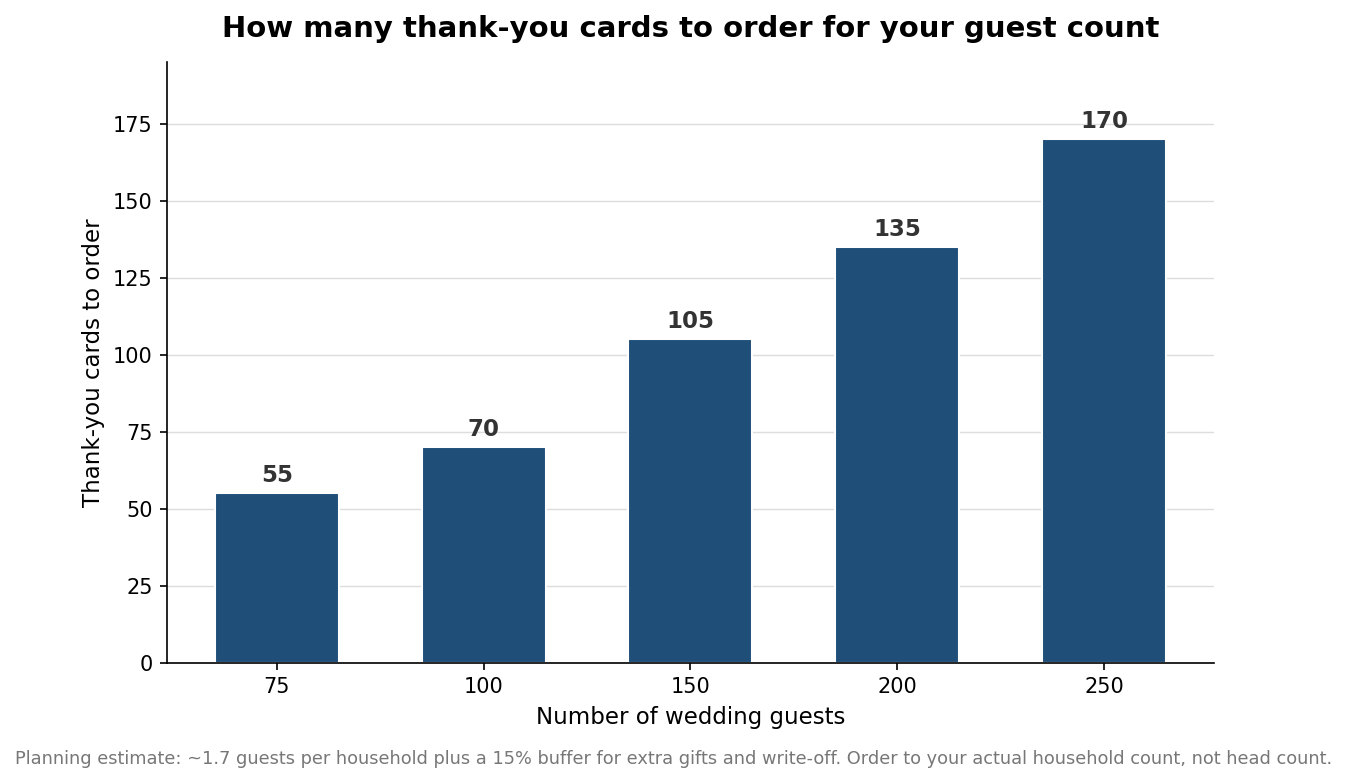
The single most common mistake is ordering one card per guest. You are not thanking people, you are thanking gifts, and gifts arrive by household. A couple who attends together and gives one gift gets one note. In practice that means your card count tracks the number of invitations that produced a gift, not the number of place settings at the reception. A useful planning ratio is roughly 1.7 guests per household, so a 150-guest wedding generates somewhere near 88 gift-giving households.
Then add a buffer of 10 to 15 percent. You will spoil a few cards mid-sentence, you will want a keepsake or two, and gifts have a way of arriving from people who never made it to the wedding. Shower and engagement-party gifts complicate the math further, because etiquette treats each gift as its own thank-you even when the same person gave all three. If you hosted pre-wedding events, order extra rather than reprinting a small second batch at a higher per-card cost. The chart below shows a reasonable starting quantity for common guest counts.
Sizes, formats, and envelopes that fit together
Two sizes dominate the category. The A2 card measures 4.25 by 5.5 inches and pairs with an A2 envelope of about 4.375 by 5.75 inches; it prints and mails cheaply and reads as a classic note card. The 5 by 7 card, which takes an A7 envelope of about 5.25 by 7.25 inches, gives you far more room for a photo or a longer printed message and delivers a more substantial in-hand feel, at a slightly higher paper and postage cost. A flat 4 by 6 postcard-style card is a third route that skips the envelope entirely and can qualify for postcard postage, which adds up across a couple hundred pieces.
Folded or flat is partly practical. A folded card hides your handwriting until it is opened and gives you a blank interior to write on, which most couples prefer for a heartfelt note. Flat cards suit photo thank-yous, where the front carries a wedding image and the back holds a short printed line plus a couple of handwritten sentences. If you are including a photo, confirm the printer’s bleed and safe-area margins so faces do not get trimmed at the edge.
Paper stock and print method set the feel and the price
Weight is what people notice first. Digitally printed thank-you cards are commonly produced on 110 to 130 lb cover stock, roughly 300 gsm, which is sturdy without being showy. Letterpress and heavy foil work want a thicker sheet, typically 300 gsm cotton or a double-thick 600 gsm cotton that holds a deep impression. Heavier stock costs more per sheet and can nudge you into a higher postage tier, so weigh a finished sample before you assume standard rates.
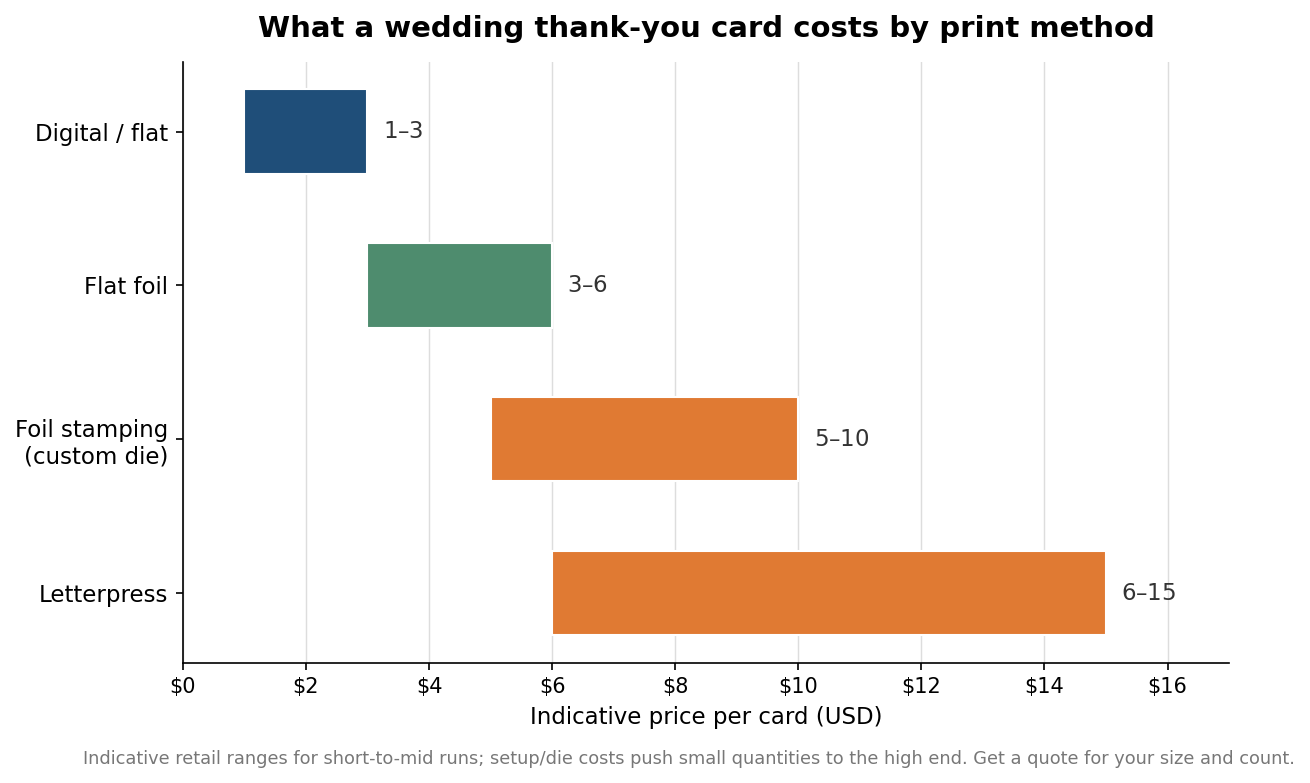
Method is the biggest lever on cost. Digital or flat printing is the value option and handles full color, gradients, and photography. Flat foil adds a metallic layer without pressing into the paper. Foil stamping presses a custom die into the sheet for a tactile mark, and letterpress debosses the design into thick cotton; both require custom plates or dies and therefore higher minimums and setup fees. The indicative per-card ranges below are for short-to-mid runs, and the setup costs are exactly why small quantities land at the top of each band. Because those fixed costs spread across the run, per-card pricing typically falls 30 to 50 percent moving from a 25-card order up to 150.
The timeline that keeps etiquette on your side
The clock starts before the wedding. For gifts that arrive ahead of the day, the widely cited standard from The Knot is to send a thank-you within about two weeks of receiving each one. For gifts given at or after the wedding, aim to have your notes out within three months of the wedding date. Waiting longer is not a catastrophe and a late note still lands warmly, but three months is the window that reads as prompt and respectful.
Order early so the cards are not the bottleneck. The practical move is to have your thank-you cards printed and waiting before the wedding, then write and send them in small batches as gifts come in rather than facing a mountain afterward. That also protects you against print lead times: digital runs often turn in a few business days to a week, while foil and letterpress can take one to three weeks once you factor in proofing. Those windows are indicative and vary by printer and season, so confirm the date in writing when you order.
Putting the order together
Work through it in one sitting. Lock your gift-giving household count and add the buffer to get a final quantity. Pick a size and confirm the matching envelope so the two are not ordered separately and mismatched. Choose a print method that fits both the look you want and the budget the quantity implies, remembering that a custom die or letterpress plate only makes sense once the run is large enough to absorb the setup. Proof the return address, any printed message, and the spelling of names on personalized cards before approving, because a typo caught on screen is free and a typo caught in the box is a reprint. Finally, order a handful of spare envelopes; they are cheap, and a smudged envelope should never cost you a whole card.
Handle those decisions up front and the only hard part left is the writing, which is the part that was always going to take a cup of coffee and a quiet afternoon.
Leave a Reply